Senator Obama gave a speech recently at the Sojourners -- Call To Renewal conference about the role of religion in public life (full text is found here). I happened to like the speech quite a bit, as did some others. But some folks in the lefty blogosphere are fairly annoyed; Kevin Drum gives a pretty good defense of Obama, but check out the long list of peeved comments.
Mostly they seem up in arms about Obama's use of the "some liberals don't like religion" canard. Which is fair enough. It's an extremely annoying way of editorializing without facts, as used by FoxNews and el Presidente Bush ad nauseum to bash liberals. So shame on Obama for falling into the RNC talkingpoints trap.
But, really, that was just 2% of an otherwise terrific speech on religion and politics and well worth the read. He talked about his personal faith journey. He talked about the biblical call to feed the hungry and house the homeless and create a more just society. Crucially (for me) he spoke of the importance of separation of church and state, and affirmed that religious folks do not have a monopoly on morality. And for the first time in a long time, the MSM was giving favorable media coverage to a Democrat talking about religion (the Chicago Sun-Times even front-paged the talk), which I'm guessing did more to bury the "liberals are anti-religion" storyline than anything else in the past two years. Awesome!
Because, of course, there is already a sizable religious left in this country; it's just not the story that the MSM wants to sell papers with right now. So changing the framing of religious issues is an absolute must for the Democratic Party. If the Republicans are an unstable alliance of the business community and the religious right, then, strategically, the Dems need to find ways to fracture that alliance and pick up the pieces, without losing their soul and becoming Republican-lite Lieberman clones. And I would argue that (oddly) it is the religious conservative voter who is more of a match for the Dems than the corporate types. Just because Coors hires Mary Cheney and runs a few gay-friendly ads does not make them our friends. Ten million photo-ops with cute endangered animals won't make Chevron environmentally friendly. Granted the leaders of the religious right (Falwell, Dobson, et al) are mostly fascist Taliban-wannabes so forget them, but the folks sitting in the pews are getting screwed, just like the rest of us.
A nice mix of economic populism (raise the damn minimum wage already, get some decent health care and more scholarships for working-class families) and ecumenical-friendly issues (end the war in Iraq, save Darfur, crack down on sex trafficking) should do a lot to break the gays-n-abortion stranglehold the religious right has put on the media these days. Anyway, Obama's main point seems to be that sincerity is the key in making these connections. Which I guess means we need more people like him making the speeches.
Wednesday, July 05, 2006

Wednesday, June 28, 2006
In appreciation of the "oldest kid"
When I started working for the HETE project as a young impressionable grad student, another scientist on the team gave me the rundown. There were "adults" and there were "kids." The "adults" on our project were a group of 6-7 principal investigators, senior scientists and full professors who were generally responsible for the broad scientific direction of the mission, press-releases, grant-writing, political arm-twisting, etc. Many of the adults maintained only a general understanding of the underlying working of the satellite and the software. The term "kids" wasn't limited to just mean grad and undergrad students, but also the group of non-professor-level Ph.D. scientists who actually ran the mission and knew what was going on day to day. When we went out for team dinners, the adults and the kids often sat at different tables and had entirely different types of conversations. Kinda like Thanksgiving with my family, in a way.
Now, having participated in two largish scientific collaborations I can say with certainty that the most crucial member of any team is the person (or sometimes, persons) you might describe as the "oldest kid." I think any good collaboration must have at least one of these. As an entering student, they are absolutely the person you go to when you want to know something and really understand the details of it. They tend to have an encyclopedic knowledge of who is an expert on 'x' issue, which students are working on 'y' calculation, and the best way to extract 'z' data product. They are traffic-directors extraordinaire. And most importantly, they communicate the nitty-gritty details upward to the adults and make sure they don't make dumb decisions for lack of understanding the facts on the ground.
They often don't publish a lot of papers or get a ton of recognition. Some may work an entire scientific career without truly joining the ranks of the "adults." But I'm convinced that without these oldest kids, the entire scientific enterprise would grind to a halt. I can certainly attest to how absolutely essential many of these people have been to me during my time in grad school. So here's to you, oldest-kid researchers! Huzzah!
Now, having participated in two largish scientific collaborations I can say with certainty that the most crucial member of any team is the person (or sometimes, persons) you might describe as the "oldest kid." I think any good collaboration must have at least one of these. As an entering student, they are absolutely the person you go to when you want to know something and really understand the details of it. They tend to have an encyclopedic knowledge of who is an expert on 'x' issue, which students are working on 'y' calculation, and the best way to extract 'z' data product. They are traffic-directors extraordinaire. And most importantly, they communicate the nitty-gritty details upward to the adults and make sure they don't make dumb decisions for lack of understanding the facts on the ground.
They often don't publish a lot of papers or get a ton of recognition. Some may work an entire scientific career without truly joining the ranks of the "adults." But I'm convinced that without these oldest kids, the entire scientific enterprise would grind to a halt. I can certainly attest to how absolutely essential many of these people have been to me during my time in grad school. So here's to you, oldest-kid researchers! Huzzah!
Tuesday, June 20, 2006
Torture Awareness Month
Lest we think the ceremonial naming of months is merely a public relations tactic employed by for lobbyists from the Pork Council or the Canadian Dental Hygienists Association, this June is Torture Awareness Month. Of course, according to Wikipedia, June is also Samurai Awareness Month, so go figure.
Sadly, torture has become a terrible blot on our country, and the time has long since passed to make some noise. We've all heard the litany of abuse: First, Bush will not be abiding by the Geneva Conventions. Then (surprised?) the photos of abuse at Abu Ghraib. Thus far only a few lowly 'bad apples' are implicated, but as Sy Hersh reported in the New Yorker, the abuse was possibly orchestrated and approved by military intelligence in a desperate attempt to gather information on the insurgency. Guantanamo Bay and the mysterious 'black sites' in Europe and Asia, have become a land beyond law, where hundreds of people have been held incommunicado and largely without access to the courts. Now there have been 3 suicides. It has become so embarassing, that Congress even passed a law prohibiting the use of torture; Bush signed it, but then delivered a signing statement claiming he will obey the law only when it suits him. This is bad.
The pro-torture apologists always tend to come up with one of two responses: (1) the bad guys do worse things, or (2) the inevitable 'ticking time bomb' scenario.
The first argument, while emotionally appealing in light of some of the horrible things that go on in the world, is just morally dumb. That sort of argument didn't cut any ice in kindergarten and sinking down to the lowest level of humanity in our national policy is no way to run a country now that we're grown-ups (well, some of us anyway). It is, at it's core, a scare tactic. The strongest argument against torture is simply that it is evil and wrong. It was wrong when Saddam and Pinochet and others did it - it's still wrong now. The fact that we are a democracy is no fig leaf here. Indeed, it makes it all our responsibility.
The second argument shows how much Hollywood action movies have informed our political debate. We can just see Bruce Willis beating the crucial life-saving info out of some sweaty terrorist, defusing the bomb, rescuing his tough (yet imperiled) former wife and delivering comeuppance to the spineless bureaucrat. Go Bruce Go! The real-world, it turns out, isn't very much like the climax of an action movie. I know, I know, it's shocking to think that Hollywood has misled us on this matter, but it's true. The vast, vast majority of people in question are not Al Qaeda masterminds with secret information about imminent attacks. Most of the prisoners at Gitmo have been there for three years or more; even if they were once high-up in AQ (and almost all of them weren't) any intelligence they might have now is worse than useless. Some were 'bought' from Afghan warlords for $5000 a head. Some were picked up on 'hunch' of some CIA officer and later released without charges after it was apparent they were nobodies. Most of the prisoners at Abu Ghraib were taxi drivers in the wrong place or the brother-in-law of some wanted insurgent picked up in a general sweep.
It's never a good idea to base your official policy on a rare case. In the heat of the moment, it's too tempting to see every situation as life-or-death, when in hindsight it's really not. We would have to ask ourselves, how many innocent people do we want to torture in order to find that needle in the haystack that will hypothetically save American lives? 1000? 10,000? And remember, such a policy means 10,000 false leads to add to the top of the haystack (if you torture someone enough they will typically say anything to make it stop). It's also pretty easy to be pro-torture when you're white and/or American; you really don't have to worry that each time you board a plane, you might end up in a cell in Syria for ten months (as happened to Maher Arar).
And what have we lost in exchange for this hypothetical gain? We've lost the respect of our allies, confirmed fears that we are an unaccountable tyranny, spawned yet more insurgents and joined a tawdry fraternity of nations condemned by Amnesty and the Red Cross. To paraphrase Karl Rove, it will take the U.S. generations to live down the Abu Ghraib pictures and gain credibility in the Middle East. It's time we started making amends.
For ideas on how to make your voice heard: http://www.tortureawareness.org/
Join Amnesty International
Sign this petition: http://www.nrcat.org
Sadly, torture has become a terrible blot on our country, and the time has long since passed to make some noise. We've all heard the litany of abuse: First, Bush will not be abiding by the Geneva Conventions. Then (surprised?) the photos of abuse at Abu Ghraib. Thus far only a few lowly 'bad apples' are implicated, but as Sy Hersh reported in the New Yorker, the abuse was possibly orchestrated and approved by military intelligence in a desperate attempt to gather information on the insurgency. Guantanamo Bay and the mysterious 'black sites' in Europe and Asia, have become a land beyond law, where hundreds of people have been held incommunicado and largely without access to the courts. Now there have been 3 suicides. It has become so embarassing, that Congress even passed a law prohibiting the use of torture; Bush signed it, but then delivered a signing statement claiming he will obey the law only when it suits him. This is bad.
The pro-torture apologists always tend to come up with one of two responses: (1) the bad guys do worse things, or (2) the inevitable 'ticking time bomb' scenario.
The first argument, while emotionally appealing in light of some of the horrible things that go on in the world, is just morally dumb. That sort of argument didn't cut any ice in kindergarten and sinking down to the lowest level of humanity in our national policy is no way to run a country now that we're grown-ups (well, some of us anyway). It is, at it's core, a scare tactic. The strongest argument against torture is simply that it is evil and wrong. It was wrong when Saddam and Pinochet and others did it - it's still wrong now. The fact that we are a democracy is no fig leaf here. Indeed, it makes it all our responsibility.
The second argument shows how much Hollywood action movies have informed our political debate. We can just see Bruce Willis beating the crucial life-saving info out of some sweaty terrorist, defusing the bomb, rescuing his tough (yet imperiled) former wife and delivering comeuppance to the spineless bureaucrat. Go Bruce Go! The real-world, it turns out, isn't very much like the climax of an action movie. I know, I know, it's shocking to think that Hollywood has misled us on this matter, but it's true. The vast, vast majority of people in question are not Al Qaeda masterminds with secret information about imminent attacks. Most of the prisoners at Gitmo have been there for three years or more; even if they were once high-up in AQ (and almost all of them weren't) any intelligence they might have now is worse than useless. Some were 'bought' from Afghan warlords for $5000 a head. Some were picked up on 'hunch' of some CIA officer and later released without charges after it was apparent they were nobodies. Most of the prisoners at Abu Ghraib were taxi drivers in the wrong place or the brother-in-law of some wanted insurgent picked up in a general sweep.
It's never a good idea to base your official policy on a rare case. In the heat of the moment, it's too tempting to see every situation as life-or-death, when in hindsight it's really not. We would have to ask ourselves, how many innocent people do we want to torture in order to find that needle in the haystack that will hypothetically save American lives? 1000? 10,000? And remember, such a policy means 10,000 false leads to add to the top of the haystack (if you torture someone enough they will typically say anything to make it stop). It's also pretty easy to be pro-torture when you're white and/or American; you really don't have to worry that each time you board a plane, you might end up in a cell in Syria for ten months (as happened to Maher Arar).
And what have we lost in exchange for this hypothetical gain? We've lost the respect of our allies, confirmed fears that we are an unaccountable tyranny, spawned yet more insurgents and joined a tawdry fraternity of nations condemned by Amnesty and the Red Cross. To paraphrase Karl Rove, it will take the U.S. generations to live down the Abu Ghraib pictures and gain credibility in the Middle East. It's time we started making amends.
For ideas on how to make your voice heard: http://www.tortureawareness.org/
Join Amnesty International
Sign this petition: http://www.nrcat.org
Tuesday, June 13, 2006
Twisted Link 'o' the Week
I saw this at an animation festival years ago and very nearly actually died laughing. Click the red balloon. What a wonderful thing is YouTube that such happy memories can be revisited often (I don't think this link has the full clip, but you'll get the idea).
Billy's Balloon, by Don Hertzfeldt
It is possible that I am a bad person for finding this funny. You have been warned.
It is possible that I am a bad person for finding this funny. You have been warned.
Monday, June 05, 2006
Star Flight
This past Friday we gave our final presentations for my museum internship. It was basically a chance to show off our work to a handful of museum bigwigs -- it actually went pretty well, for the most part.
My group worked on two interactive computer exhibits. One exhibit (that I didn't work on very much) let people physically play with a virtual sound wave by moving an IR wand -- faster wand movement == smaller wavelength == higher frequency sound, and vice versa. The exhibit I worked primarily on (called 'StarFlight') allows people to fly through a 3D virtual reality model of our local universe with a video game controller.
For the most part it is very, very difficult to determine distances to astronomical objects -- in many ways, the problem of distance has been the central problem in astronomy for centuries now (and hopefully the topic of a future blog post). As a result, for many objects on the sky, we have very good 2D information, but only a rough estimate of the 3rd coordinate of radial distance. Inside a comparatively small radius about our sun, accurate distances to other stars in our galaxy can be determined through stellar parallax (which measures the apparent shift in positions of stars as the Earth goes around the Sun). The gold standard for this sort of measurement comes from the European Hipparcos satellite, which measured the parallaxes (and hence the distance to) nearly 120,000 of our closest stellar neighbors.
But more importantly, for our purposes, this dataset gives us a full 3D picture of our local corner of the Milky Way galaxy. Our exhibit lets the user "fly" through this cloud of stars just like a video game. Using this data, it's fun to consider what familiar constellations look like from different vantage points. For example, my sign is Scorpio, and this is what the constellation Scorpius looks like from Earth:

But when we fly off to one side and take a look it assumes this crazy zig-zag shape because some stars are really close to our sun and others are really far away. Our sun is represented by the tiny white circle on the far left that all the blue lines are "pointing to".

The basic implementation of the program is a mix between free form exploring of the stars with the video game controller, and a more guided tour of a few famous constellations, complete with narration explaining astronomical concepts and giving the mythological stories behind the shape. We also have an animated intro that puts everything in context by blasting off from downtown Chicago (Adler Planetarium actually) and launching us into the solar system, and finally out into the sea of nearby stars. The program can run on anything from a laptop screen (Mac, Win, Linux) to a GeoWall (a relatively inexpensive stereo 3D system that many museums use).
Implementing this exhibit took the combined efforts of many people, and it was aided infinitely by the existence of the very cool and super-useful electro application development environment. We will be distributing "StarFlight" on the web (link TBD) once we iron out a few more kinks, but since we based our program on a simpler implementation of the Hipparcos catalog (the 'total perspective vortex') that comes bundled with the electro download, you can try it yourself right away if you like. As a teaser here's an image of 'vortex' running on the 100-megapixel, 11x5 tiled display at the Electronics Visualization Lab at UIC. (Tangent: Can I just say EVL has some pretty impressive toys? In addition to the tiled display, we got to play with some of their varrier displays, which use various forms of eye- and head-tracking to create a personal stereoscopic 3D display without the use of annoying stereo glasses, which always give me a headache. They have it set up to do 3D video conferencing, which is a little freaky.)
So anyway, perhaps this exhibit will be effective in teaching a few basic astronomy ideas (stars are far away, but get brighter when you get close to them), and hopefully it will have a high 'cool factor' to hook visitors into playing with it. Participating in this project has given me nothing but respect for people who design human-computer interactions and museum exhibits. It is just not easy to design an object to do your communicating for you. With luck, 'StarFlight' will end up playing at SciTech Hands-On Museum in Aurora, IL (and maybe somewhere else too), and at any rate, was a lot of fun to make.
My group worked on two interactive computer exhibits. One exhibit (that I didn't work on very much) let people physically play with a virtual sound wave by moving an IR wand -- faster wand movement == smaller wavelength == higher frequency sound, and vice versa. The exhibit I worked primarily on (called 'StarFlight') allows people to fly through a 3D virtual reality model of our local universe with a video game controller.
For the most part it is very, very difficult to determine distances to astronomical objects -- in many ways, the problem of distance has been the central problem in astronomy for centuries now (and hopefully the topic of a future blog post). As a result, for many objects on the sky, we have very good 2D information, but only a rough estimate of the 3rd coordinate of radial distance. Inside a comparatively small radius about our sun, accurate distances to other stars in our galaxy can be determined through stellar parallax (which measures the apparent shift in positions of stars as the Earth goes around the Sun). The gold standard for this sort of measurement comes from the European Hipparcos satellite, which measured the parallaxes (and hence the distance to) nearly 120,000 of our closest stellar neighbors.
But more importantly, for our purposes, this dataset gives us a full 3D picture of our local corner of the Milky Way galaxy. Our exhibit lets the user "fly" through this cloud of stars just like a video game. Using this data, it's fun to consider what familiar constellations look like from different vantage points. For example, my sign is Scorpio, and this is what the constellation Scorpius looks like from Earth:
But when we fly off to one side and take a look it assumes this crazy zig-zag shape because some stars are really close to our sun and others are really far away. Our sun is represented by the tiny white circle on the far left that all the blue lines are "pointing to".
The basic implementation of the program is a mix between free form exploring of the stars with the video game controller, and a more guided tour of a few famous constellations, complete with narration explaining astronomical concepts and giving the mythological stories behind the shape. We also have an animated intro that puts everything in context by blasting off from downtown Chicago (Adler Planetarium actually) and launching us into the solar system, and finally out into the sea of nearby stars. The program can run on anything from a laptop screen (Mac, Win, Linux) to a GeoWall (a relatively inexpensive stereo 3D system that many museums use).
 |  |
 |  |
Implementing this exhibit took the combined efforts of many people, and it was aided infinitely by the existence of the very cool and super-useful electro application development environment. We will be distributing "StarFlight" on the web (link TBD) once we iron out a few more kinks, but since we based our program on a simpler implementation of the Hipparcos catalog (the 'total perspective vortex') that comes bundled with the electro download, you can try it yourself right away if you like. As a teaser here's an image of 'vortex' running on the 100-megapixel, 11x5 tiled display at the Electronics Visualization Lab at UIC. (Tangent: Can I just say EVL has some pretty impressive toys? In addition to the tiled display, we got to play with some of their varrier displays, which use various forms of eye- and head-tracking to create a personal stereoscopic 3D display without the use of annoying stereo glasses, which always give me a headache. They have it set up to do 3D video conferencing, which is a little freaky.)
So anyway, perhaps this exhibit will be effective in teaching a few basic astronomy ideas (stars are far away, but get brighter when you get close to them), and hopefully it will have a high 'cool factor' to hook visitors into playing with it. Participating in this project has given me nothing but respect for people who design human-computer interactions and museum exhibits. It is just not easy to design an object to do your communicating for you. With luck, 'StarFlight' will end up playing at SciTech Hands-On Museum in Aurora, IL (and maybe somewhere else too), and at any rate, was a lot of fun to make.
Sunday, May 28, 2006


Saturday, May 27, 2006
Lame Things About Good Movies
I've seen a lot of good movies lately. All of these are highly recommended, despite my complaining.
Film: King Kong
General Impression: I was trawling through a video store while the giant-bug-attack scene was playing on the TV screens, and every single person in the store stopped what they were doing and gaped at the screen with their jaws hanging open until it was over. Tremendously creepy scene. The rest of the movie swings from one wildly implausible situation to the next (think dinosaurs fighting while swinging on jungle vines), but it never stops entertaining and never slows down long enough for you to realize how bizarre it all is. Andy Serkis is amazing (again), and The Empire State building scene is nicely done.
Part That Sucked: The portrayal of the natives. OK, I get that Peter Jackson is remaking a film from an earlier time and deliberately not updating it to reflect modern sensibilities, but still, this is a little over the top. The Skull Islanders aren't just aboriginals, they're also evil - you can tell by their crazed, glassy eyes and stringy hair, and the freaky, guttural chanting. What gives? He might as well have cast the Orcs from LOTR. Maybe he was trying to save money by reusing the costumes.
Film: Munich
General Impression: Political violence and and our notions of when and how it can be legitimate is something I've always obsessed about (see here and here), and so it goes without saying that I found 'Munich' to be pretty fascinating. Oddly it reminded me of the Bourne movies -- heart-pounding action sequences set in the capitals of Europe -- and highlighted the truth that most spy movies are pretty empty-headed. Although it's probably to Steven Spielberg and Tony Kushner's credit that they managed to anger both sides of the Israeli-Palestinian debate, I don't think the movie is best thought of as an opinion piece about the Middle East. The focus of its argument is on the psychological effects of violence on those who commit it. All told, an extremely exciting and thought-provoking film; rent this with 'Paradise Now' and talk amongst yourselves.
Part That Sucked: OK, this is more of a tangent, but one bit of the film that sticks with me is the offhand remark by an Israeli general that the targeted killings of the terrorists are unnecessary since Israel has alreadyretaliated for the Munich killings by bombing training camps (in Lebanon and Syria) and killing 60 (a Palestinian character later puts the number at 200). Still -- 60 people? All guilty terrorists we presume? Or maybe random people in the wrong place at the wrong time? Or if some were innocent, are we are to think that those killings are less heinous because they are 'accidental'? And then the movie asks us to agonize over the targetted killings? Perhaps we should be more worried that our technology now allows us to kill without directly experiencing the violence, and that that dehumanizes us even more. But that's a different movie, I suppose.
Film: The New World
General Impression: A beautiful film. It's opening mirrors both the opening passage of Howard Zinn's history and Wagner's narrative of innocence lost, with the shimmery prelude to Das Rheingold playing as the Virginia natives look out on the arriving ships of the English settlers. The movie barely manages a narrative, instead offering up a series of poetic images roughly telling the story of Pocahontas, John Smith and the Jamestown settlement. It bogs a bit in the middle, but the scenes in the native village and later when she travels to England to meet the royals are pretty much perfect.
Part That Sucked: Hollywood seems to have a one-hit-movie quota for beautiful, accomplished non-white and/or non-western actresses, and then it's back to television and independent films with them. Cases in point: Irene Bedard, Ming-Na, Keisha Castle-Hughes, Catalina Sandino Moreno, Sarita Choudhury, etc. So its worth hoping Q'Orianka Kilcher, the young native actress who plays Pocahontas, gets to act in another movie again someday ever, and isn't doomed to a career of bit-parts on Law and Order.
Film: King Kong
General Impression: I was trawling through a video store while the giant-bug-attack scene was playing on the TV screens, and every single person in the store stopped what they were doing and gaped at the screen with their jaws hanging open until it was over. Tremendously creepy scene. The rest of the movie swings from one wildly implausible situation to the next (think dinosaurs fighting while swinging on jungle vines), but it never stops entertaining and never slows down long enough for you to realize how bizarre it all is. Andy Serkis is amazing (again), and The Empire State building scene is nicely done.
Part That Sucked: The portrayal of the natives. OK, I get that Peter Jackson is remaking a film from an earlier time and deliberately not updating it to reflect modern sensibilities, but still, this is a little over the top. The Skull Islanders aren't just aboriginals, they're also evil - you can tell by their crazed, glassy eyes and stringy hair, and the freaky, guttural chanting. What gives? He might as well have cast the Orcs from LOTR. Maybe he was trying to save money by reusing the costumes.
Film: Munich
General Impression: Political violence and and our notions of when and how it can be legitimate is something I've always obsessed about (see here and here), and so it goes without saying that I found 'Munich' to be pretty fascinating. Oddly it reminded me of the Bourne movies -- heart-pounding action sequences set in the capitals of Europe -- and highlighted the truth that most spy movies are pretty empty-headed. Although it's probably to Steven Spielberg and Tony Kushner's credit that they managed to anger both sides of the Israeli-Palestinian debate, I don't think the movie is best thought of as an opinion piece about the Middle East. The focus of its argument is on the psychological effects of violence on those who commit it. All told, an extremely exciting and thought-provoking film; rent this with 'Paradise Now' and talk amongst yourselves.
Part That Sucked: OK, this is more of a tangent, but one bit of the film that sticks with me is the offhand remark by an Israeli general that the targeted killings of the terrorists are unnecessary since Israel has alreadyretaliated for the Munich killings by bombing training camps (in Lebanon and Syria) and killing 60 (a Palestinian character later puts the number at 200). Still -- 60 people? All guilty terrorists we presume? Or maybe random people in the wrong place at the wrong time? Or if some were innocent, are we are to think that those killings are less heinous because they are 'accidental'? And then the movie asks us to agonize over the targetted killings? Perhaps we should be more worried that our technology now allows us to kill without directly experiencing the violence, and that that dehumanizes us even more. But that's a different movie, I suppose.
Film: The New World
General Impression: A beautiful film. It's opening mirrors both the opening passage of Howard Zinn's history and Wagner's narrative of innocence lost, with the shimmery prelude to Das Rheingold playing as the Virginia natives look out on the arriving ships of the English settlers. The movie barely manages a narrative, instead offering up a series of poetic images roughly telling the story of Pocahontas, John Smith and the Jamestown settlement. It bogs a bit in the middle, but the scenes in the native village and later when she travels to England to meet the royals are pretty much perfect.
Part That Sucked: Hollywood seems to have a one-hit-movie quota for beautiful, accomplished non-white and/or non-western actresses, and then it's back to television and independent films with them. Cases in point: Irene Bedard, Ming-Na, Keisha Castle-Hughes, Catalina Sandino Moreno, Sarita Choudhury, etc. So its worth hoping Q'Orianka Kilcher, the young native actress who plays Pocahontas, gets to act in another movie again someday ever, and isn't doomed to a career of bit-parts on Law and Order.
Tuesday, May 23, 2006
Make My Funk the P-Funk
Yeah! We saw Dar Williams, RJD2 and George Clinton + Parliament/Funkadelic at the annual Summer Breeze concert Saturday night. Dar had some funny jokes about finally sharing a stage with George Clinton, but that's exactly why Summer Breeze is so awesome: a few years ago they had Guided By Voices, Jurassic 5 and Medeski, Martin & Wood on the same stage. Talk about eclectic. Anyway, the concert was awesome.
Dar: This was the 4th time I've seen her in concert, and it was nice to hear her do the solo guitar thing without her backing band (which sometimes makes her sound a little too adult-contempo-lite-rock-y). As usual, she was her funny, goofy self, and she played a nice mix of old and new stuff. Apart from a small group of acolytes around the stage, a lot of the crowd wasn't really paying that much attention, which was too bad. A lot of them didn't even sing along to 'Iowa' even though she promised them it would get them into bed with cute girls. Their loss, I guess.
RJD2: Pretty cool DJ music. The thing about seeing DJ's spin live is that I don't really know enough about what's going on to be properly impressed. He certainly ran around, shuffled vinyl and did stuff with the 4 or 5 turntables he had, and the music that came forth was really interesting and engaging, but I'm never really sure (without getting a closeup view) exactly which "parts" he's creating through cut-n-paste and which are pre-recorded. I'm happy to take it on faith that he's a real badass, however.
P-Funk: Pretty much a religious experience. I did have a moment of doubt early on... (I mean, GC's been doing this for, what? 30-40 years? And he's clearly an old man now. Even the guy in the diaper is an old man, and he's been wearing that diaper for-ev-er. So, is this just a nostalgia act? Are they merely a party band now, here to get the frat boys pumped up? You can just imagine how crazy and dangerous and anarchic they must have seemed back in the 70's when they ruled this planet and several others from the deck of their mothership. And now the anarchy has been going on so long, it's become... pre-planned - is that weird? or sad? or something?) ... but then I decided to stop thinking about it and dance. And, really, they still don't compare to anything else out there - the passing years have only made them better at what they do. There were like 147 of them up there on stage -- 14 guitarists, 8 keyboard players, 64 backup singers, the male-belly dancer/acrobat with a six-inch prosthetic nose dressed up like a pimp and climbing all over the stage, the guy eating cereal, the skinny sound-tech guy breaking up fights, the female rapper, the keyboardist who looks like Che, the guitarist with the half-hour solos that would make the Grateful Dead have to take a break and sit down, and on and on... in the end you can't fight the funk. You have to join it.
Dar: This was the 4th time I've seen her in concert, and it was nice to hear her do the solo guitar thing without her backing band (which sometimes makes her sound a little too adult-contempo-lite-rock-y). As usual, she was her funny, goofy self, and she played a nice mix of old and new stuff. Apart from a small group of acolytes around the stage, a lot of the crowd wasn't really paying that much attention, which was too bad. A lot of them didn't even sing along to 'Iowa' even though she promised them it would get them into bed with cute girls. Their loss, I guess.
RJD2: Pretty cool DJ music. The thing about seeing DJ's spin live is that I don't really know enough about what's going on to be properly impressed. He certainly ran around, shuffled vinyl and did stuff with the 4 or 5 turntables he had, and the music that came forth was really interesting and engaging, but I'm never really sure (without getting a closeup view) exactly which "parts" he's creating through cut-n-paste and which are pre-recorded. I'm happy to take it on faith that he's a real badass, however.
P-Funk: Pretty much a religious experience. I did have a moment of doubt early on... (I mean, GC's been doing this for, what? 30-40 years? And he's clearly an old man now. Even the guy in the diaper is an old man, and he's been wearing that diaper for-ev-er. So, is this just a nostalgia act? Are they merely a party band now, here to get the frat boys pumped up? You can just imagine how crazy and dangerous and anarchic they must have seemed back in the 70's when they ruled this planet and several others from the deck of their mothership. And now the anarchy has been going on so long, it's become... pre-planned - is that weird? or sad? or something?) ... but then I decided to stop thinking about it and dance. And, really, they still don't compare to anything else out there - the passing years have only made them better at what they do. There were like 147 of them up there on stage -- 14 guitarists, 8 keyboard players, 64 backup singers, the male-belly dancer/acrobat with a six-inch prosthetic nose dressed up like a pimp and climbing all over the stage, the guy eating cereal, the skinny sound-tech guy breaking up fights, the female rapper, the keyboardist who looks like Che, the guitarist with the half-hour solos that would make the Grateful Dead have to take a break and sit down, and on and on... in the end you can't fight the funk. You have to join it.
Monday, May 22, 2006
Science Blog!
For my museum internship, we've been asked to contribute posts to the Science Buzz Blog that's a part of the Science Museum of Minnesota. Keith and I decided to post on the recent formation of a second Red Spot on the face of Jupiter. You can read our full posting by clicking here.
Anyway, check out their blog - it's pretty cool, and they're always looking for people to leave comments and initiate discussion.
Anyway, check out their blog - it's pretty cool, and they're always looking for people to leave comments and initiate discussion.
Dear NSA,
Funny Link of the (unspecified time period),
I especially like the Liberian scam one. Substantive blog post coming soon, I plomise.
I especially like the Liberian scam one. Substantive blog post coming soon, I plomise.
Thursday, May 11, 2006
gripe gripe gripe
Ugh. What a 'orrible day. 40 degrees, rainy, windy. And of course I left the house without a coat or a functioning umbrella. And why would I do that, you might ask? Because, dammit, it's the middle of May already!
Stupid Chicago "spring". For some reason I can handle ten-below-zero in January. That's even kind of exciting (assuming a warm coat, of course). But, I expect spring to arrive on March 1 like clockwork, and by May, the continued appearance of damp, frigid weather drives me a little... crazy. Hee.
Stupid Chicago "spring". For some reason I can handle ten-below-zero in January. That's even kind of exciting (assuming a warm coat, of course). But, I expect spring to arrive on March 1 like clockwork, and by May, the continued appearance of damp, frigid weather drives me a little... crazy. Hee.
Tuesday, May 02, 2006
Mayday
In celebration of Mayday, I managed to make it to three separate protests yesterday: the massive immigrants rights march, the Mayday celebration in Haymarket Square and the Save Darfur Rally. This involved a lot of quality time spent on the Green Line to and from Hyde Park. Here are my reflections; sorry if they're a bit lengthy.
Immigrants Rights March
The mainstream papers are reporting that in Chicago alone, nearly half a million people turned out for the immigrant rights march, so the total number was at least that many. When I arrived at Union Park at around 11:30, people were already heading down Randolph towards downtown. I never personally saw the beginning or the end of the sea of marchers. The crush of people was already threatening to swamp the CTA's capacity. My train was packed solid, almost entirely Latino families: strollers, little kids waving homemade "No on 4437" signs, teenagers wearing Mexican and American flags like capes, a constant hum of Spanish. Just getting out of the Ashland El stop took 10 minutes.

The day is grey and threatening rain, but thankfully, the promised thunderstorms hold their distance. Union Park is awash in people. Since the march started on the West Side, the Latino turnout was understandably enormous -- probably more than 90% of those marching. But this being Chicago, there is a substantial Polish contingent as well, many of whom are 'sin papeles' and come here to work in the construction trade or as janitors. There are certainly a good fraction of Mexican and Polish flags, but mostly it's the Stars and Stripes. Street vendors are selling a combo-pack of U.S. and Mexican flags for $4. I think this may be the most American flags I've ever seen at one time. Everytime the news helicopters do a flyby the crowd cheers and starts waving like crazy.


The cops funnelled the march out of the park through a very narrow gate, and then only let us march on one side of Randolph, even though the other lanes were closed to traffic. This meant that for the first hour the mass of people I was with moved about 500 yards. Not so much marching for immigration justice, as shuffling slowly forward. Once we got past the bottleneck, it sped up a bit.

At this point, a feeder march of anarchist youth joined the column to great cheering. The Black Bloc kids brought a lot of energy with homemade drums and loud chants of 'Si Se Puede', and, because they've never seen a police line not worth crossing, they streamed over into the unused lanes, overturned the blue barricades and encouraged everyone else to cross over as well.

Some of the older marchers seemed uncertain and a little annoyed about this confrontation, but large numbers of high school and college aged kids crossed the median onto the other side. The cops made a panicked show of blocking these lanes with their bikes and trying to force us back into line, but the pressure of so many people was too great and after a few minutes they surrendered the right side of the street and the people flowed into it. I can understand the annoyance towards a group of mostly (but not entirely) white kids provoking a confrontation with the cops during a peaceful, family oriented march, but the police-lines were ridiculous and anyway, it ended well.
There were a lot of great signs. The one in the picture above says "My Brother is in Iraq fighting for his country." Other favorites:

Part of the UNITE-HERE contingent.

This is the view from the top of the Kennedy overpass, looking back on the throngs of people. For myself, I have to say that it was incredibly moving to be a part of this march. Everything about it had the feel of an organic, grassroots uprising for justice. There were undoubtedly tireless organizers who threw themselves into making this march a success, but the impetus for half-a-mil to leave work and come out into the streets could only have come from a deep, visceral understanding that their very existence in this country is under attack. There are too few times in history when such a mass mobilization happens. The trick now is to focus all this energy on getting specific legislation pushed through.
For the record, we've been told for so long that corporations and gobs of capital should be stateless and free to go wherever they want in the world, so to me it seems only fair to allow the same for humans. But since an 'open border' policy isn't going to be passed anytime soon, I hope for an immigration policy that strongly rejects criminalization of people already here, that allows a path toward permanent legal status and citizenship, and that gives immigrants equal rights and access to services. I know that amnesty is not the most popular proposal right now, but it is the goal we need to work for. Call your reps, go to a rally and sign this petition.
Mayday Celebration in Haymarket Square
I had to drop out of the immigration march before it finished at Grant Park, but I headed back downtown later in the afternoon for the Mayday rally. Most of the rest of the world celebrates May 1 as International Workers Day, except the US, even though the history of the date started here in Chicago.
On May 4, 1886, during a rally of unionists protesting the killing of two strikers by the Chicago police the day before, a bomb was thrown by someone at the watching police (killing several) and the police retaliated by firing upon the crowd killing several and injuring many more. The state convicted eight anarchists for inciting the crowd to riot (even though no evidence linked any of them to the bomb-thrower). Four anarchists, August Spies, Albert Parsons, Adolph Fischer and George Engel, were executed on November 11, 1887. Since then, Mayday has been a cause celebre for labor unions and left-wing political parties in most countries, except here, where its celebration was stamped out by the Red Scare. Good histories of the riots can be found here and here.
These days Haymarket Square is a completely non-descript strip of sidewalk, west of the downtown, and perched above the Kennedy Expressway. For years, a statue of a police officer stood here commemorating the incident, until it was bombed by the Weather Underground in the late 60's. After years of antagonism between the police and the labor unions about the history of the incident, the city agreed two years ago to put up a new memorial statue as part of a proposed Labor Park. Chicago labor unions have been trying to reclaim this bit of history as theirs, and so staged a worker's rights rally there this year. It was cool to be at Haymarket for Mayday and to support the local unions, but the rally was small and fairly tepid in comparison with the immigration march.


Save Darfur Rally
Our final stop of the day was Federal Plaza for the Save Darfur rally. I was struck first off by the tremendous diversity of the participants. White folks, black folks, awesome suburban high school kids, a huge Jewish presence. A singer ran through a medley of freedom songs from Bob Marley to the Beatles. It definitely felt like a movement growing beyond the usual activisty suspects. The message was a little unfocused ("We need action! Now!", but what?), but the passion was tangible.
There were a bunch of speakers, but two really stood out. The first was Father Michael Pfleger of St. Sabina Faith Community. If you ever get a chance to check out the worship service at St. Sabina, it really has to be seen to be believed. Father Pfleger is a true fire-breathing, truth-telling, social-justice preacher, and he set the place on fire, issuing a strong condemnation of any church, synagogue or mosque that remains silent or apathetic about genocide. The second speaker was the Imam Senad Agic, of the Northbrook Mosque (a Bosnian Muslim, with first-hand experience of genocide), who put the issue in plain words: the Quran says, anyone who kills an innocent person, it is as if they are killing the entire world, and anyone who saves someone from death, it is as if they have saved the entire world.

The mainstream papers are reporting that in Chicago alone, nearly half a million people turned out for the immigrant rights march, so the total number was at least that many. When I arrived at Union Park at around 11:30, people were already heading down Randolph towards downtown. I never personally saw the beginning or the end of the sea of marchers. The crush of people was already threatening to swamp the CTA's capacity. My train was packed solid, almost entirely Latino families: strollers, little kids waving homemade "No on 4437" signs, teenagers wearing Mexican and American flags like capes, a constant hum of Spanish. Just getting out of the Ashland El stop took 10 minutes.
The day is grey and threatening rain, but thankfully, the promised thunderstorms hold their distance. Union Park is awash in people. Since the march started on the West Side, the Latino turnout was understandably enormous -- probably more than 90% of those marching. But this being Chicago, there is a substantial Polish contingent as well, many of whom are 'sin papeles' and come here to work in the construction trade or as janitors. There are certainly a good fraction of Mexican and Polish flags, but mostly it's the Stars and Stripes. Street vendors are selling a combo-pack of U.S. and Mexican flags for $4. I think this may be the most American flags I've ever seen at one time. Everytime the news helicopters do a flyby the crowd cheers and starts waving like crazy.
The cops funnelled the march out of the park through a very narrow gate, and then only let us march on one side of Randolph, even though the other lanes were closed to traffic. This meant that for the first hour the mass of people I was with moved about 500 yards. Not so much marching for immigration justice, as shuffling slowly forward. Once we got past the bottleneck, it sped up a bit.
At this point, a feeder march of anarchist youth joined the column to great cheering. The Black Bloc kids brought a lot of energy with homemade drums and loud chants of 'Si Se Puede', and, because they've never seen a police line not worth crossing, they streamed over into the unused lanes, overturned the blue barricades and encouraged everyone else to cross over as well.
Some of the older marchers seemed uncertain and a little annoyed about this confrontation, but large numbers of high school and college aged kids crossed the median onto the other side. The cops made a panicked show of blocking these lanes with their bikes and trying to force us back into line, but the pressure of so many people was too great and after a few minutes they surrendered the right side of the street and the people flowed into it. I can understand the annoyance towards a group of mostly (but not entirely) white kids provoking a confrontation with the cops during a peaceful, family oriented march, but the police-lines were ridiculous and anyway, it ended well.
There were a lot of great signs. The one in the picture above says "My Brother is in Iraq fighting for his country." Other favorites:
"Today I March, Tomorrow I Vote"
"Somos America"
"Las luchas de los obreros no tienen fronteras"
"Sacar corriendo el gobierno de Bush"
"All religions believe in Justice"
"Queremos Legalizacion"
"Amnistia!"
"Immigrants and Workers Forged America"
"Somos America"
"Las luchas de los obreros no tienen fronteras"
"Sacar corriendo el gobierno de Bush"
"All religions believe in Justice"
"Queremos Legalizacion"
"Amnistia!"
"Immigrants and Workers Forged America"
Part of the UNITE-HERE contingent.
This is the view from the top of the Kennedy overpass, looking back on the throngs of people. For myself, I have to say that it was incredibly moving to be a part of this march. Everything about it had the feel of an organic, grassroots uprising for justice. There were undoubtedly tireless organizers who threw themselves into making this march a success, but the impetus for half-a-mil to leave work and come out into the streets could only have come from a deep, visceral understanding that their very existence in this country is under attack. There are too few times in history when such a mass mobilization happens. The trick now is to focus all this energy on getting specific legislation pushed through.
For the record, we've been told for so long that corporations and gobs of capital should be stateless and free to go wherever they want in the world, so to me it seems only fair to allow the same for humans. But since an 'open border' policy isn't going to be passed anytime soon, I hope for an immigration policy that strongly rejects criminalization of people already here, that allows a path toward permanent legal status and citizenship, and that gives immigrants equal rights and access to services. I know that amnesty is not the most popular proposal right now, but it is the goal we need to work for. Call your reps, go to a rally and sign this petition.
I had to drop out of the immigration march before it finished at Grant Park, but I headed back downtown later in the afternoon for the Mayday rally. Most of the rest of the world celebrates May 1 as International Workers Day, except the US, even though the history of the date started here in Chicago.
On May 4, 1886, during a rally of unionists protesting the killing of two strikers by the Chicago police the day before, a bomb was thrown by someone at the watching police (killing several) and the police retaliated by firing upon the crowd killing several and injuring many more. The state convicted eight anarchists for inciting the crowd to riot (even though no evidence linked any of them to the bomb-thrower). Four anarchists, August Spies, Albert Parsons, Adolph Fischer and George Engel, were executed on November 11, 1887. Since then, Mayday has been a cause celebre for labor unions and left-wing political parties in most countries, except here, where its celebration was stamped out by the Red Scare. Good histories of the riots can be found here and here.
These days Haymarket Square is a completely non-descript strip of sidewalk, west of the downtown, and perched above the Kennedy Expressway. For years, a statue of a police officer stood here commemorating the incident, until it was bombed by the Weather Underground in the late 60's. After years of antagonism between the police and the labor unions about the history of the incident, the city agreed two years ago to put up a new memorial statue as part of a proposed Labor Park. Chicago labor unions have been trying to reclaim this bit of history as theirs, and so staged a worker's rights rally there this year. It was cool to be at Haymarket for Mayday and to support the local unions, but the rally was small and fairly tepid in comparison with the immigration march.
Our final stop of the day was Federal Plaza for the Save Darfur rally. I was struck first off by the tremendous diversity of the participants. White folks, black folks, awesome suburban high school kids, a huge Jewish presence. A singer ran through a medley of freedom songs from Bob Marley to the Beatles. It definitely felt like a movement growing beyond the usual activisty suspects. The message was a little unfocused ("We need action! Now!", but what?), but the passion was tangible.
There were a bunch of speakers, but two really stood out. The first was Father Michael Pfleger of St. Sabina Faith Community. If you ever get a chance to check out the worship service at St. Sabina, it really has to be seen to be believed. Father Pfleger is a true fire-breathing, truth-telling, social-justice preacher, and he set the place on fire, issuing a strong condemnation of any church, synagogue or mosque that remains silent or apathetic about genocide. The second speaker was the Imam Senad Agic, of the Northbrook Mosque (a Bosnian Muslim, with first-hand experience of genocide), who put the issue in plain words: the Quran says, anyone who kills an innocent person, it is as if they are killing the entire world, and anyone who saves someone from death, it is as if they have saved the entire world.
Wednesday, April 26, 2006
Watersheds
As I was standing atop Starved Rock this past weekend, I had a revelation that is probably boring and obvious to a lot of locals, but I really hadn't understood how it worked until an informational sign enlightened me. This is the problem: the watershed in the Chicago area is really strange. For example, the water in Lake Michigan (and the entire Great Lakes Basin) flows to the Atlantic Ocean via the St. Lawrence seaway. But, most of Illinois flows to the Mississippi River and then to the Gulf of Mexico.
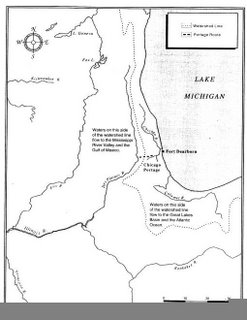
As this map shows, the line demarking these two watersheds is just outside Chicago and rings Lake Michigan. And it's not like there's a great mountain ridge running along that dotted line - it's just prairie, swamp and dunes (or nowadays, suburbs). In fact the difference is so slight that canal projects in the 1800s were able to reverse the flow of the Chicago River so it flows out of Lake Michigan (and hence to the Mississippi as well). I mean, everyone always jokes about how the Chicago River goes the wrong way, but I never understood until now what that means. Does anyone else think it's strange that the watershed line is so close to the lakeshore?
In a sense, this geographic burp is kind of why Chicago is such an important city. Ever since Jolliet and Marquette, people had been looking for a passage between the Great Lakes and the Mississippi so they could ship things easier to different places. Just outside Chicago was where the portage was shortest, and once the canals were dug the city grew rich on the shipping trade. Now it all makes sense!
There's an excellent overview of all this to be found here (which is also where I stole the map image from; please don't sue me).
As this map shows, the line demarking these two watersheds is just outside Chicago and rings Lake Michigan. And it's not like there's a great mountain ridge running along that dotted line - it's just prairie, swamp and dunes (or nowadays, suburbs). In fact the difference is so slight that canal projects in the 1800s were able to reverse the flow of the Chicago River so it flows out of Lake Michigan (and hence to the Mississippi as well). I mean, everyone always jokes about how the Chicago River goes the wrong way, but I never understood until now what that means. Does anyone else think it's strange that the watershed line is so close to the lakeshore?
In a sense, this geographic burp is kind of why Chicago is such an important city. Ever since Jolliet and Marquette, people had been looking for a passage between the Great Lakes and the Mississippi so they could ship things easier to different places. Just outside Chicago was where the portage was shortest, and once the canals were dug the city grew rich on the shipping trade. Now it all makes sense!
There's an excellent overview of all this to be found here (which is also where I stole the map image from; please don't sue me).
Tuesday, April 25, 2006
Starved Rock
We recently bought a new tent, and this weekend we tried it out at Starved Rock State Park, which is this really lovely little park halfway to Iowa along the Illinois River.

The campground was pretty gourmet as far as car-camping goes, and not too crowded yet. I can imagine the place rivals downtown Manhattan come July. Lots of RVs and kids on bikes. We were psyched to have a campfire, and the site we picked even had some leftover firewood. Yet, having forgotten a lighter, we lacked the technology to actually make fire. Hmm. We had seen signs advertising firewood as we entered the campground "Jack's Firewood and Stuff", so we set off to find Jack. Turns out, Jack doesn't run a store but is this really nice old guy who lives on this ridiculously picturesque country road and who sells firewood out of his front yard for $5 a stack (leave the cash in the thermos, thanks!). Since we didn't need any firewood, he loaned us matches and threw in some old newspapers. Super nice guy. And now we had a campfire.

And when the sun went down, the stars came out. Now I've been spending the past several months designing a museum exhibit on constellations and the local stars, but I realized that I hadn't seen actual stars in months. And the night was clear and beautiful - perfect for stargazing.

The next morning it was warm and sunny, with the first signs of the woods coming alive for spring.

This is the view of the Illinois River from the top of Starved Rock, which is a layer-cake rock outcropping right above the river. Legend has it in the 1760's an Illiniwek war-party was besieged on the rock by Ottawa warriors avenging the killing of their chief, Pontiac. The Illini refused to surrender and they all starved to death. The park has had the good taste to not put a snack shop on the top.


Here's some pictures of us hiking around.

A view of Starved Rock from "Lover's Leap" (another cheerful story behind that one, I'm sure).

Here's Laura Jean looking cute. The watershed region of the Illinois River is pretty interesting in itself (I'll probably devote another post to it). The dam prevents this part of the river from freezing solid, and so bald eagles come to the park in the winter to fish. We didn't see any, but we did watch a barge go through the locks, which was kinda cool.

The park is mostly twisting canyons and waterfalls, which is weird for Illinois. I wouldn't really have guessed that there were things high enough for water to fall off of in this state, but this canyon was deep and cool and very peaceful, with a great waterfall back in the nook.

The nearby town of Utica is pretty adorable as well; 1000 people, nearly all of them proprietors of tiny shops or cafes along the Main Street. The vision of a church steeple perfectly framed by two grain silos is what greets you as soon as you enter the town from the interstate. Perfect.
The campground was pretty gourmet as far as car-camping goes, and not too crowded yet. I can imagine the place rivals downtown Manhattan come July. Lots of RVs and kids on bikes. We were psyched to have a campfire, and the site we picked even had some leftover firewood. Yet, having forgotten a lighter, we lacked the technology to actually make fire. Hmm. We had seen signs advertising firewood as we entered the campground "Jack's Firewood and Stuff", so we set off to find Jack. Turns out, Jack doesn't run a store but is this really nice old guy who lives on this ridiculously picturesque country road and who sells firewood out of his front yard for $5 a stack (leave the cash in the thermos, thanks!). Since we didn't need any firewood, he loaned us matches and threw in some old newspapers. Super nice guy. And now we had a campfire.
And when the sun went down, the stars came out. Now I've been spending the past several months designing a museum exhibit on constellations and the local stars, but I realized that I hadn't seen actual stars in months. And the night was clear and beautiful - perfect for stargazing.
The next morning it was warm and sunny, with the first signs of the woods coming alive for spring.
This is the view of the Illinois River from the top of Starved Rock, which is a layer-cake rock outcropping right above the river. Legend has it in the 1760's an Illiniwek war-party was besieged on the rock by Ottawa warriors avenging the killing of their chief, Pontiac. The Illini refused to surrender and they all starved to death. The park has had the good taste to not put a snack shop on the top.
Here's some pictures of us hiking around.
A view of Starved Rock from "Lover's Leap" (another cheerful story behind that one, I'm sure).
Here's Laura Jean looking cute. The watershed region of the Illinois River is pretty interesting in itself (I'll probably devote another post to it). The dam prevents this part of the river from freezing solid, and so bald eagles come to the park in the winter to fish. We didn't see any, but we did watch a barge go through the locks, which was kinda cool.
The park is mostly twisting canyons and waterfalls, which is weird for Illinois. I wouldn't really have guessed that there were things high enough for water to fall off of in this state, but this canyon was deep and cool and very peaceful, with a great waterfall back in the nook.
The nearby town of Utica is pretty adorable as well; 1000 people, nearly all of them proprietors of tiny shops or cafes along the Main Street. The vision of a church steeple perfectly framed by two grain silos is what greets you as soon as you enter the town from the interstate. Perfect.
Monday, April 24, 2006
Dream Jobs
I've started taking a Career Exploration Seminar through the U of Chicago's CAPS service. Since I'm planning on making a leap out of academia and into some interesting and useful job in September, I'm hoping this class will help me focus what I want to do and give me some tips on resumes, networking and how to get hired. Anyway, one of the first things they had us do was to make a list of what we would do with our lives in some ideal universe. Here's mine, in no particular order:
Here's another list of jobs that aren't quite what I'm looking for, but seem like they would also be fairly cool.
- Travel the world, learn lots of languages and live overseas for a while (but not forever).
- Be a rabble-rouser of some sort, i.e. community organizer, etc.
- Write science-fiction novels.
- Stay at home and raise the kids.
- Be a really good high school math or science teacher, who makes students love (or at least not hate) math and science.
- Work as a bread baker.
Here's another list of jobs that aren't quite what I'm looking for, but seem like they would also be fairly cool.
- Nicholas Kristof's job: I imagine that this is what many an aspiring journalist daydreams about doing: traveling the globe, talking to interesting people about human rights, exposing corruption and abuse, rousing rabble, raking muck, etc. These days, this is dominated by independent and/or foreign journalists since most corporate American media outlets don't put very much money money into investigative or international reporting any more. Among mainstream American journalism, Kristof seems to be the only big name who does this, but he does it well enough to score a Pulitzer. (By the way, how much does TimesSelect suck? I mean, I shoveled out the money for it, but still... thumbs down)
- Google: Granted, they're probably the next incarnation of Big Brother (unless they really do stick to the "don't be evil" rule). But they do give their software engineers some large percentage of their time free to dream up cool stuff, like this, and this, and this, and this ...
- Movie Reviewer: It still amazes me that some people get paid to do this.
The Storybook Project
When inmates make collect calls (the only calls they can make) from Cook County Jail, it costs their families 3 to 4 times the usual rate to accept the charges. It's a small thing I suppose, but like a lot of things in our correctional system, it seems like they're going out of their way to be rapacious and unfair and counter-productive. Talk about kicking someone when they're down. Does price gouging poor people and isolating inmates from their families and communities serve the common good in the long run? Does it make our streets safer or reduce recidivism? I very much doubt it. But, of course, it's a safe bet for the phone companies (or the jail, or whoever's idea it was) that sticking it to prisoners won't win them any enemies, even while it fattens their profit margins. The invisible hand is more like an invisible fist when you've got a monopoly and a captive market (so to speak).
This last Saturday, Laura Jean and I went with 3 other folks from our church to the Cook County Jail for our first session volunteering with Aunt Mary's Storybook Project. We had our orientation about two months ago, but hadn't been allowed inside the jail since, due to security lockdowns. These may have had something to do with, oh I don't know... the jailbreak that occurred just a few days after our first visit, and subsequent allegations that prison officers may have had a hand in the escape. So yeah, they've been having some security "issues", but they finally decided to let us in this past weekend.
Just getting into the jail is quite a task. Your name has to be on the right piece of paper, you get patted down (twice), go through a metal detector and an ion scanner. Not all of the officers seem tense and unhelpful, but after a while you feel like some of them are looking for any excuse to toss you out. So, you learn to be very polite and helpful at all times. The system is highly bureaucratic, yet oddly incompetent -- we had to ask them to carefully search the cart of books we brought in, not wanting to get busted for any accidental contraband and lose our right to do our program. Go figure.
Anyway, we finally got everything set up in one of the gyms, and they sent us an initial group of 15-20 mothers from the women's ward and we explained the program to them. We told them that we were there to give them a chance to connect with their kids. We had boxes and boxes of children's books for all ages (from 'Pat the Bunny' through 'Harry Potter') and tape-recorders so that they could read the book aloud to their kids (or sing them a song, or send them a message). We would then mail the book and the tape to the children. The kicker is, when we explained the program to them, there was an audible response, and at least three women started crying right off the bat. This, of course, made it tough for the rest of us to keep a dry eye. We got started by helping them pick out the right books for each of their kids, and handed them a tape-recorder.
The few hours I've spent in CCJ give me the impression that it is a pretty rough place -- hugely overcrowded and oppressive. A few years back there was a big scandal about the officers beating the crap out of the inmates (read the full Chicago Tribune coverage here). In CCJ, almost everyone is awaiting trial. Laura Jean tells me that the prisons downstate are calmer since everyone knows how many years they're looking at. Although some have been awaiting trial for a year or two, everyone in the jail is on edge and unsure what will happen to them. I should say that probably most of the women in CCJ are there for drug-related crimes (see also here), either possession or property-crimes related to a drug problem. The War on Drugs marches on.
Anyway, there are some times when you're doing a service project and you wonder whether it will have any impact at all: this was not one of those times. The women were all completely down with the project and they spent every last minute they could reading into the recorders and writing letters to their kids. I got a very strong impression that the books and tapes were filling a painful gap for them. A few women cried through the entire book; others were excited and everyone seemed grateful in the end. Communication out of the jail is very difficult; in addition to the collect calls, they have to buy paper, envelopes and stamps through the commissary just to write a letter. It may not be a systematic fix for a broken system, but if it helps keep even a few families from shattering completely it's a success.
This last Saturday, Laura Jean and I went with 3 other folks from our church to the Cook County Jail for our first session volunteering with Aunt Mary's Storybook Project. We had our orientation about two months ago, but hadn't been allowed inside the jail since, due to security lockdowns. These may have had something to do with, oh I don't know... the jailbreak that occurred just a few days after our first visit, and subsequent allegations that prison officers may have had a hand in the escape. So yeah, they've been having some security "issues", but they finally decided to let us in this past weekend.
Just getting into the jail is quite a task. Your name has to be on the right piece of paper, you get patted down (twice), go through a metal detector and an ion scanner. Not all of the officers seem tense and unhelpful, but after a while you feel like some of them are looking for any excuse to toss you out. So, you learn to be very polite and helpful at all times. The system is highly bureaucratic, yet oddly incompetent -- we had to ask them to carefully search the cart of books we brought in, not wanting to get busted for any accidental contraband and lose our right to do our program. Go figure.
Anyway, we finally got everything set up in one of the gyms, and they sent us an initial group of 15-20 mothers from the women's ward and we explained the program to them. We told them that we were there to give them a chance to connect with their kids. We had boxes and boxes of children's books for all ages (from 'Pat the Bunny' through 'Harry Potter') and tape-recorders so that they could read the book aloud to their kids (or sing them a song, or send them a message). We would then mail the book and the tape to the children. The kicker is, when we explained the program to them, there was an audible response, and at least three women started crying right off the bat. This, of course, made it tough for the rest of us to keep a dry eye. We got started by helping them pick out the right books for each of their kids, and handed them a tape-recorder.
The few hours I've spent in CCJ give me the impression that it is a pretty rough place -- hugely overcrowded and oppressive. A few years back there was a big scandal about the officers beating the crap out of the inmates (read the full Chicago Tribune coverage here). In CCJ, almost everyone is awaiting trial. Laura Jean tells me that the prisons downstate are calmer since everyone knows how many years they're looking at. Although some have been awaiting trial for a year or two, everyone in the jail is on edge and unsure what will happen to them. I should say that probably most of the women in CCJ are there for drug-related crimes (see also here), either possession or property-crimes related to a drug problem. The War on Drugs marches on.
Anyway, there are some times when you're doing a service project and you wonder whether it will have any impact at all: this was not one of those times. The women were all completely down with the project and they spent every last minute they could reading into the recorders and writing letters to their kids. I got a very strong impression that the books and tapes were filling a painful gap for them. A few women cried through the entire book; others were excited and everyone seemed grateful in the end. Communication out of the jail is very difficult; in addition to the collect calls, they have to buy paper, envelopes and stamps through the commissary just to write a letter. It may not be a systematic fix for a broken system, but if it helps keep even a few families from shattering completely it's a success.
Monday, April 17, 2006
Working Weekend
Over the past four days I have attended five church services at two congregations for a total 6.5 hours and Lord knows how many hymns. Not to mention a church volunteer trip on Saturday to Cook County Jail ("the real work of the church", as Laura Jean said). I'm pretty sure that that is more church than I logged during the entire Clinton administration. Turns out Holy Weekend is a working weekend for preacher's spouses too. Still, it was pretty fun. Maundy Thursday, Good Friday, we got to see friends confirmed into their church Saturday night (which almost burned down, but then didn't), attended a very nice sunrise service on Sunday, and capped it off with a completely fabulous sermon from Susan at the full Easter service. And then we all got up on stage and sang the "Hallelujah" chorus together to close it out. Amen indeed!
And now I can drink beer again! Yay!
And now I can drink beer again! Yay!
Saturday, April 08, 2006
Goin' back to Cali
A few weeks back we had a really nice mini-vacation to California. Kinda like "spring break", except neither of us are students any longer. It was just five days but we packed a lot of stuff into them. Anyway, here are some pics...
The main impetus for the trip was that Laura Jean's little brother, Eric, is getting himself hitched this summer to a lovely young woman named Holly. They attend college in New Mexico and were travelling by train to Nevada City, CA, where her family lives, and so they stopped over in Fresno at my parents' house for a few days. Since Laura Jean had yet to meet Holly, we took it as an opportunity to kill several birds with one stone.

The happy couple and Laura Jean. We wanted to hike down by the San Joaquin River, and even though it was rainy and gross, we were brave and did it any way.

There were some really good rocks for skipping.

Hanging out with Eric and Holly was great, but they had to be on their way to meet her Mom for the first time (da da da!), so we set out to enjoy California for ourselves. We took one day to meet up with friends and go hiking on the coast in Santa Cruz. I had forgotten how much I miss the Pacific Ocean, having moved to the heartland for the past six years. Dad, Jessica, Laura Jean and Sandhya in front of a natural bridge.

More beautiful coastline...

Jess on the beach.

Ocean waves.

A raucous (and quite green) St. Patrick's Day party with the Knapps.

We spent Saturday visiting more friends in Berkeley. The rain had finally rained itself away, and we were treated to one of those days that makes the Bay Area the most wonderful place in the universe. It was warm and sunny -- everything was positively luminous. This is the view from our friends' apartment in the Berkeley hills. Amazingly, you can see the Golden Gate and downtown San Francisco from their porch.

Kate, Laura Jean, Alex and Becca enjoying a brunchly idyll.

We spent far too little time hanging out with Jessica and Cathy, but we'll take what we can get.
The main impetus for the trip was that Laura Jean's little brother, Eric, is getting himself hitched this summer to a lovely young woman named Holly. They attend college in New Mexico and were travelling by train to Nevada City, CA, where her family lives, and so they stopped over in Fresno at my parents' house for a few days. Since Laura Jean had yet to meet Holly, we took it as an opportunity to kill several birds with one stone.
The happy couple and Laura Jean. We wanted to hike down by the San Joaquin River, and even though it was rainy and gross, we were brave and did it any way.
There were some really good rocks for skipping.
Hanging out with Eric and Holly was great, but they had to be on their way to meet her Mom for the first time (da da da!), so we set out to enjoy California for ourselves. We took one day to meet up with friends and go hiking on the coast in Santa Cruz. I had forgotten how much I miss the Pacific Ocean, having moved to the heartland for the past six years. Dad, Jessica, Laura Jean and Sandhya in front of a natural bridge.
More beautiful coastline...
Jess on the beach.
Ocean waves.
A raucous (and quite green) St. Patrick's Day party with the Knapps.
We spent Saturday visiting more friends in Berkeley. The rain had finally rained itself away, and we were treated to one of those days that makes the Bay Area the most wonderful place in the universe. It was warm and sunny -- everything was positively luminous. This is the view from our friends' apartment in the Berkeley hills. Amazingly, you can see the Golden Gate and downtown San Francisco from their porch.
Kate, Laura Jean, Alex and Becca enjoying a brunchly idyll.
We spent far too little time hanging out with Jessica and Cathy, but we'll take what we can get.
Wednesday, April 05, 2006
night lights
There's a lot of things I will miss about Chicago when we move away. One small thing is the beauty of its skyline. Here are two photos taken from the bar atop the John Hancock Building, looking west...

and south.

Taken when we were lucky enough to have Carina visiting us.
and south.
Taken when we were lucky enough to have Carina visiting us.
Sunday, April 02, 2006
Shamrock Shuffle
Today I ran in the Shamrock Shuffle (advertised as the "largest 8K in the world!" with 25,000 participants). For starters, the weather report was saying something about it being in the high-50s today, but actually it was a cold 40 with wind when the race started. Thankfully it didn't start raining until after. Not exactly what you would call a "nice day for a run", but whatever. I've done this race for the past two years, and its generally a fun time. You get to run through the downtown streets and lots of people come out to watch. I've been telling myself I'd like to run at a 7 minute pace (5 miles = 35 minutes), but actually I'd be happy with 8 minutes and my knee ligament not hurting (its been twinging a bit on my last few runs). Anyway, 'ere's the play-by-play:
We have the option of getting a free beer and listening to live music, but for me, the idea of standing shivering in the rain drinking a beer by myself at 10am on a Sunday morning sounds too much like an operational definition of alcoholism. I put on my windbreaker and try to track down a bus back home.
Of course, all the bus routes are screwed up by the race, but I do eventually find a 6 bus and am extremely grateful to be out of the rain and cold. But then as we're turning south onto Lake Shore, the bus sideswipes a cab. I didn't even feel the collision and it looked like nobody was hurt, but we had to sit in the bus, blocking traffic, for about 25 minutes until the next 6 came along to rescue us.
ps: ---
My official time was 0:38:09, which I think is identical to last year down to the second (a 7:38 pace) and which places me 2386th out of 20,408 finishers (top 12%). Among men I finished 1966th, and 494th in my division (age 25-29). The mens and womens champions clocked in at a mind-wowing 23:52 and 26:27, respectively. All in all, it was pretty fun time. Pictures coming soon, hopefully.
- Mile 1: Start out north on Columbus, right past the Gehry alien spacecraft and then into the underground streets. The downtown, stripped of its cars, is totally transformed -- it feels a bit like being in a music video or something. The pack of runners is quite crowded, and in the tunnel the thump thump thump of our shoes is the only sound. I start out fast and feel pretty good. We cross the river, quite windy, turn on Grand.
Time = 7:10 - Mile 2: Head back across the river on State. I don't think I'll be able to keep up the 7 minute pace, but I'm still feeling pretty good - no twinges in my knee yet. Crowd starts to thin out a bit.
Time = 7:30 Total = 14:40 - Mile 3: Mmm, gatorade. My ankle and shin start to feel a little tight, maybe I'm overcompensating for the knee? Anyway, we turn west on Jackson and head out over the river again. There's a pretty good crowd cheering us on, which is cool. When I look down the side streets, I can see the front-runners already returning in the other direction, almost a mile ahead.
Time = 7:40 Total = 22:20 - Mile 4: Return east on Van Buren. Starting to feel a... little... tired. I slow my pace just a bit, and wonder why there aren't bands serenading us along the route like last year. OK, starting to feel more than a little tired. Breathe in, breathe out, remember to keep your stride long.
Time = 8:00 Total = 30:20 - Mile 5: OK, we turn south onto Michigan and it's just a mile left. Despite wanting to die, I pick up the pace a bit. Only a mile left, right? Then someone decides it would be funny to end the race with the only hill in Northern Illinois - it's uphill along Roosevelt to the corner with Columbus. Brutal. But after that it's only 300m and I try to finish strongly. I manage to cross the finish with arms upraised for the cameras.
Time = 7:50 Total = 38:10
We have the option of getting a free beer and listening to live music, but for me, the idea of standing shivering in the rain drinking a beer by myself at 10am on a Sunday morning sounds too much like an operational definition of alcoholism. I put on my windbreaker and try to track down a bus back home.
Of course, all the bus routes are screwed up by the race, but I do eventually find a 6 bus and am extremely grateful to be out of the rain and cold. But then as we're turning south onto Lake Shore, the bus sideswipes a cab. I didn't even feel the collision and it looked like nobody was hurt, but we had to sit in the bus, blocking traffic, for about 25 minutes until the next 6 came along to rescue us.
ps: ---
My official time was 0:38:09, which I think is identical to last year down to the second (a 7:38 pace) and which places me 2386th out of 20,408 finishers (top 12%). Among men I finished 1966th, and 494th in my division (age 25-29). The mens and womens champions clocked in at a mind-wowing 23:52 and 26:27, respectively. All in all, it was pretty fun time. Pictures coming soon, hopefully.
Subscribe to:
Posts (Atom)