Yesterday was the 25th anniversary of the Bhopal disaster -- a massive chemical release at a Union Carbide plant in India that killed between 4 and 10,000 people in the first few days and more than 20,000 people in the years since. The Big Picture devotes its daily photo essay to the tragedy, which can be seen here.
Justice for the victims has been elusive and the company (naturally) claims its innocence. Union Carbide (now owned by Dow Chemical) settled with the Indian government for a pathetically small sum in 1989 and the actual victims saw very little of the cash. Furthermore, the company never cleaned up the site, chemicals from which are apparently still leaking into the local groundwater. There is apparently a warrant out for the arrest of the former CEO, should he ever set foot in India.
So yeah, a pretty crappy situation. If you're interested in learning more check out Students for Bhopal, who recently helped organize a series of actions to mark the anniversary.
Showing posts with label activism. Show all posts
Showing posts with label activism. Show all posts
Friday, December 04, 2009

Wednesday, October 28, 2009
Violence in the Amazon
I meant to blog about this when it occurred, but in June tensions between amazonian indigenous tribes and the Peruvian government boiled over into violence that left dozens of policemen and indigenous protesters dead. The conflict was about oil exploration: the government is pushing for it, the indigenous groups are fighting it.
The incident itself is a little murky, with both sides claiming different stories of "who shot first." Tragically it seems possible that early, inflated reports of the indigenous death count may have led to revenge killings of captured policemen. The fallout does not seem to have resolved the underlying issues at all. You can find good round-ups of news coverage from Amazon Watch and Climate Science Watch.
A few weeks ago, a similar indigenous protest in Ecuador--this time over a new law governing mining and water rights--also turned violent, leading to scores of injuries and at least one death. The fallout from this confrontation seems to be more constructive than in Peru, with the left-wing Correa government accepting talks with the protesters and apparently agreeing to some of their demands. Again, Amazon Watch has the news round-up.
In Ecuador at least, the indigenous people are very well organized, very interested in protecting their sovereignty and (at 35% of the population) a voting bloc to be reckoned with. They are also on the cutting edge of movements for environmental protection. I am less familiar with the situation in Peru, but it is an issue I'm hoping to learn more about.
The incident itself is a little murky, with both sides claiming different stories of "who shot first." Tragically it seems possible that early, inflated reports of the indigenous death count may have led to revenge killings of captured policemen. The fallout does not seem to have resolved the underlying issues at all. You can find good round-ups of news coverage from Amazon Watch and Climate Science Watch.
A few weeks ago, a similar indigenous protest in Ecuador--this time over a new law governing mining and water rights--also turned violent, leading to scores of injuries and at least one death. The fallout from this confrontation seems to be more constructive than in Peru, with the left-wing Correa government accepting talks with the protesters and apparently agreeing to some of their demands. Again, Amazon Watch has the news round-up.
In Ecuador at least, the indigenous people are very well organized, very interested in protecting their sovereignty and (at 35% of the population) a voting bloc to be reckoned with. They are also on the cutting edge of movements for environmental protection. I am less familiar with the situation in Peru, but it is an issue I'm hoping to learn more about.
Saturday, October 17, 2009
Crude
I just saw the new documentary, Crude, directed by Joe Berlinger about the lawsuit brought against Chevron on behalf of 30,000 indigenous Ecuadoreans over contamination from oil exploration. The film is quite good, probably the best and most accessible introduction to the issue that you will find, although I'm not sure in how many theaters it can be found.
The film focuses on the lawyers, particularly the American Stephen Donziger who has been pushing the suit for decades pro bono (although he stands to make a hefty sum if they win) and the Ecuadoreans Pablo Fajardo and Luis Yanza. Fajardo is the star, self-effacing but quietly charismatic -- he grew up impoverished in the oil fields, putting himself through law school at night to finally lead the legal team, in the process winning international environmental awards and getting profiled in glossy magazines. Donziger comes off as your stereotypical bossy American, although you have to admire the guy's tenacity and street smarts.
The filmmakers are clearly on the side of the locals, although they give Chevron plenty of space to (attempt to) defend their record and don't hesitate to question the motives and tactics of the plaintiffs. Their overall take on the situation is pretty similar to what we learned when we visited the region earlier this year, namely: Chevron is guilty as hell (although PetroEcuador is no angel either) and the prospect of a $27 billion payout has prompted them to pull every trick in the book to avoid it.
The highlight of the film are the on-site inspections of the waste oil pits performed by the court-appointed expert, which serve as a forum for the lawyers to go toe-to-toe. Fajardo presses his case amplified by testimony from a band of local residents, while Chevron is represented by a lawyer who might as well be straight from central casting. Great courtroom drama from the middle of a rainforest.
Anyway, well worth seeing. Here's the trailer.
The film focuses on the lawyers, particularly the American Stephen Donziger who has been pushing the suit for decades pro bono (although he stands to make a hefty sum if they win) and the Ecuadoreans Pablo Fajardo and Luis Yanza. Fajardo is the star, self-effacing but quietly charismatic -- he grew up impoverished in the oil fields, putting himself through law school at night to finally lead the legal team, in the process winning international environmental awards and getting profiled in glossy magazines. Donziger comes off as your stereotypical bossy American, although you have to admire the guy's tenacity and street smarts.
The filmmakers are clearly on the side of the locals, although they give Chevron plenty of space to (attempt to) defend their record and don't hesitate to question the motives and tactics of the plaintiffs. Their overall take on the situation is pretty similar to what we learned when we visited the region earlier this year, namely: Chevron is guilty as hell (although PetroEcuador is no angel either) and the prospect of a $27 billion payout has prompted them to pull every trick in the book to avoid it.
The highlight of the film are the on-site inspections of the waste oil pits performed by the court-appointed expert, which serve as a forum for the lawyers to go toe-to-toe. Fajardo presses his case amplified by testimony from a band of local residents, while Chevron is represented by a lawyer who might as well be straight from central casting. Great courtroom drama from the middle of a rainforest.
Anyway, well worth seeing. Here's the trailer.
Thursday, October 15, 2009
Blog Action Day!
Today is Blog Action Day and the focus is on climate change. At this very instant I don't have anything deep to say about global warming except this: the U.S. is contemplating a complete restructuring of our energy system to address a very serious, but slow-moving, problem. On the crazy off-chance that the science is wrong and climate change isn't really a big deal what is the downside to having restructured our energy system away from fossil fuels and toward renewables? Not so much, really.
UCS's latest report -- Climate 2030 -- finds that policies that transition the country to a clean energy economy will end up saving people and businesses a lot of money through lower electricity bills, energy efficiency, green jobs and the like.
For those of us who live in areas with crappy air quality, reducing conventional air pollution (a potential side benefit of greenhouse gas reductions) could save tens of thousands of lives annually. Yes, that disgusting brown air actually does kill people, mostly via heart attacks and respiratory illnesses. And if you're worried about our dependence on foreign oil or happen to live near a mountain-top removal coal operation, this one is a no-brainer too.
Anyway, for more climate blogging I suggest checking out Dave Roberts, Joe Romm and Andy Revkin. Or check out this really interesting post on the climate impact of your wardrobe.
UCS's latest report -- Climate 2030 -- finds that policies that transition the country to a clean energy economy will end up saving people and businesses a lot of money through lower electricity bills, energy efficiency, green jobs and the like.
For those of us who live in areas with crappy air quality, reducing conventional air pollution (a potential side benefit of greenhouse gas reductions) could save tens of thousands of lives annually. Yes, that disgusting brown air actually does kill people, mostly via heart attacks and respiratory illnesses. And if you're worried about our dependence on foreign oil or happen to live near a mountain-top removal coal operation, this one is a no-brainer too.
Anyway, for more climate blogging I suggest checking out Dave Roberts, Joe Romm and Andy Revkin. Or check out this really interesting post on the climate impact of your wardrobe.
Sunday, May 24, 2009
Ecuador tidbits
Just to write them down before they fade (amazing how quickly that happens), some final thoughts on our trip to Ecuador.
- Southern Stars. It being my first trip to the southern hemisphere (albeit, barely) I was looking forward to seeing the southern stars. Unfortunately, the only nights spent outside of Quito were spent in the rain forest, where (it turns out) it rains a lot. We could see the stars one night while we were driving, and it was definitely neat to see Orion in the northern sky, but no primo star-gazing opportunities. Reason to go back, I guess.
- Volcán. The Andes mountains are really cool and we got to see several active-ish volcanoes. In addition to Guagua Pichincha--which looms over Quito and erupted spectacularly in 1999--we also spied El Reventador and Sumaco from the air on our flight to Coca and we drove right past the base of Tungurahua en route to Baños (which owes its thermal hot springs to the volcano's proximity).

- Chevron. In this week's Economist you can read the basic pro-corporate defense of Chevron. The authors do not seem to have bothered to interview anyone from the other side of the lawsuit and several of their assertions do not pass the smell test IMHO. In particular, the idea that Ecuador made tens of billions from oil exploration while poor, pitiful Texaco only made $500 million is laughable and inconsistent with other facts presented in the article. Chevron Pit has the full rebuttal here.
- Organize! We heard an interesting bit of history from Yury, our guide, about Monseñor Leonidas Proaño. Before the land reform laws of the 1960s, Ecuador's poor were essentially serfs, bound to the large haciendas. When Proaño became bishop of Riobamba in 1954, a region that was poor and mostly Quichua-speaking, he began to preach liberation and agitate for social justice. He even convinced parts of the Church to give up their large land-holdings. He also founded something called the Popular Radiophonic Schools, which trained leaders and community organizers. According to Yury many of young volunteers from the Radiophonic School are now leaders of the national indigenous rights organizations or are making policy in the national assembly and the Correa government.

Friday, May 15, 2009
Bike to Work
Today was national Bike To Work Day. I went with some co-workers to the DC event and we got our picture taken with Secretary of Energy, Steven Chu.

Sunday, May 10, 2009
60 Minutes on Chevron
Apropos of my earlier post on the Chevron in Ecuador lawsuit, 60 Minutes just did a really nice and informative segment on the issue. Chevron does not come out smelling like roses here and it is great that the issue is getting wider attention. (Video not embedded because of a really annoying ad that automatically starts playing - click the link to watch.)
(Via ChevronToxico.com.)
(Via ChevronToxico.com.)
Tuesday, March 10, 2009
Deserved Mockery
Here's a funny article from the Chicago Maroon about a visit by members of the odious (and utterly irrelevant) Westboro Baptist Church to the U of Chicago campus (apparently to protest Obama).
The counter-protest signs are pretty clever, especially "God (hearts) Internet Porn," "God Hates the New Facebook" and the typically literate "Jesus rebuked the fig as an evil abomination." As the student says, "If you need scanty biblical evidence for anything, we’ve got it." Go Maroons! (Via.)
The counter-protest signs are pretty clever, especially "God (hearts) Internet Porn," "God Hates the New Facebook" and the typically literate "Jesus rebuked the fig as an evil abomination." As the student says, "If you need scanty biblical evidence for anything, we’ve got it." Go Maroons! (Via.)
Wednesday, March 04, 2009
40th Anniversary
Forty years ago today, students and faculty at M.I.T. organized a series of teach-ins to protest "the misuse of scientific and technical knowledge" and to call for the redirection of scientific resources to help solve "pressing environmental and social problems." Out of those teach-ins, the Union of Concerned Scientists was born; a bit more UCS history can be found here.
Tuesday, February 24, 2009
New Years in Sarayaku (Part 2)
After collapsing into tent we were awoken quite early the next morning by the sound of drums. Apparently in Sarayaku, New Year's Eve is for dancing and New Year's Day is the time for more traditional observances. Some of the men began walking from house to house drumming even before the sun was up.
We spent the next two days talking to several of the local leaders and absorbing the beauty of the jungle. On New Year's Day we relaxed and observed some of the festivities, which were a mix of traditional dancing, speech-making and yet more chicha.
In our discussions we heard about the village's resistance to oil exploration on their land. Around 2003, the Argentine company CGC won the right from the Quito government to begin seismic testing in the area. All fine except that the Sarayacans were adamantly opposed to the project -- they were not interested in repeating what happened to the northern oil fields. Resistance to the oil companies took the form of actively escorting company employees off their land (among other things) as can be seen in the documentary, Soy Defensor de la Selva:
[The film was made by Heriberto Gualinga, a local Sarayacan filmmaker. He was nice enough to meet with us, screen his film and answer questions while we were there. The above clip is about 1/3 of the whole film -- the other two parts can be found here and here.]
The confrontation grew more serious when the Ecuadorean army was called in to back up the oil company (later in the film, you can see the Sarayacan women also confronting and disarming the soldiers). There were allegations that the army kidnapped and tortured 4 young men from the village. But in the end Sarayacu was successful. The NY Times had a decent rundown of the conflict and others like it in this article.
It was clear from talking with people that conflict with the oil companies had radicalized Sarayacu. Except "radical" isn't quite the right word. More like: focused their desire to control they way the interacted with the outside world.
There are some indigenous groups in Ecuador -- most famously some communities of the Huaorani -- who live deep in the rain forest and have voluntarily isolated themselves from outside culture. Sarayacu is most emphatically not one of those. Sarayacu has internet access, an agricultural college, solar and gasoline power, flush toilets, and a website. They have opened up their village to eco-tourists (like us), both to cultivate allies and to replace income that might have come from oil contracts.
We also spoke briefly with Marlon Santi, who is the current president of CONAIE - the largest indigenous organization in Ecuador. He pointed out that this local political savvy mirrors the growing political clout of indigenous communities in the wider Ecuadorean politics. Periodic popular uprisings organized by CONAIE have won indigenous people greater control over their lands and have even helped topple a few governments. The indigenous movement has also been on the cutting edge of environmental activism in Ecuador.
There is a lot more to say about our time in Sarayacu, but primarily I was deeply impressed by their gracious hospitality and by the thoughtfulness with which they negotiated their interactions with the outside world. They had clearly thought hard about how they wanted to "develop" their corner of the world, weighed the pros and cons -- and I definitely got the sense that they are in the driver's seat.
We spent the next two days talking to several of the local leaders and absorbing the beauty of the jungle. On New Year's Day we relaxed and observed some of the festivities, which were a mix of traditional dancing, speech-making and yet more chicha.
In our discussions we heard about the village's resistance to oil exploration on their land. Around 2003, the Argentine company CGC won the right from the Quito government to begin seismic testing in the area. All fine except that the Sarayacans were adamantly opposed to the project -- they were not interested in repeating what happened to the northern oil fields. Resistance to the oil companies took the form of actively escorting company employees off their land (among other things) as can be seen in the documentary, Soy Defensor de la Selva:
[The film was made by Heriberto Gualinga, a local Sarayacan filmmaker. He was nice enough to meet with us, screen his film and answer questions while we were there. The above clip is about 1/3 of the whole film -- the other two parts can be found here and here.]
The confrontation grew more serious when the Ecuadorean army was called in to back up the oil company (later in the film, you can see the Sarayacan women also confronting and disarming the soldiers). There were allegations that the army kidnapped and tortured 4 young men from the village. But in the end Sarayacu was successful. The NY Times had a decent rundown of the conflict and others like it in this article.
It was clear from talking with people that conflict with the oil companies had radicalized Sarayacu. Except "radical" isn't quite the right word. More like: focused their desire to control they way the interacted with the outside world.
There are some indigenous groups in Ecuador -- most famously some communities of the Huaorani -- who live deep in the rain forest and have voluntarily isolated themselves from outside culture. Sarayacu is most emphatically not one of those. Sarayacu has internet access, an agricultural college, solar and gasoline power, flush toilets, and a website. They have opened up their village to eco-tourists (like us), both to cultivate allies and to replace income that might have come from oil contracts.
We also spoke briefly with Marlon Santi, who is the current president of CONAIE - the largest indigenous organization in Ecuador. He pointed out that this local political savvy mirrors the growing political clout of indigenous communities in the wider Ecuadorean politics. Periodic popular uprisings organized by CONAIE have won indigenous people greater control over their lands and have even helped topple a few governments. The indigenous movement has also been on the cutting edge of environmental activism in Ecuador.
There is a lot more to say about our time in Sarayacu, but primarily I was deeply impressed by their gracious hospitality and by the thoughtfulness with which they negotiated their interactions with the outside world. They had clearly thought hard about how they wanted to "develop" their corner of the world, weighed the pros and cons -- and I definitely got the sense that they are in the driver's seat.
Wednesday, February 11, 2009
New Years in Sarayaku (Part 1)
The morning we entered the rain forest we stopped first at a vista point to gaze and take pictures. Geographically speaking we were at the far western edge of the Amazon watershed, still in the shadow of the Andes Mountains, some two-thousand miles away from the mouth of the river. I remember being struck by the vast wilderness we could see, and the realization that an even greater vastness stretched on over the horizon. The forest seemed so mighty, and yet we had just seen evidence of its fragility too.
The previous day we had driven from Quito to Puyo (via Banos); today our destination was the village of Sarayaku - a five to seven hour canoe ride from the end of a gravel road. Apart from an airstrip (which was under construction) the Rio Bobonaza is the only road to Sarayaku. We were very privileged to travel on canoes with outboard motors; almost all the people we met traveled via pole-power, which lengthens the trip from five hours to two days.
The canoe ride was long and uncomfortable, but mostly totally amazing. As we went downstream the trees got taller and the forest got denser. There were occasional houses, but mostly just the river, the trees and us. The water-level was fairly low, so the canoe ran aground at most bends in the river and we made slow progress. After about four hours we reached the (largish) village of Pacayaku, and that's where things started to get unusual.
First, we were accosted by new year's eve revelers: two teenage boys dressed in drag and waving naked barbie dolls charged out to greet the boat. They shouted at us to give them some spare change (apparently this is a common Ecuadorian new years tradition) and anyone who didn't got splashed.
Second, we stopped for gasoline at the driver's brother's house and we were invited up to drink some chicha, a (pretty alcoholic) drink made of fermented yuca. A new year's eve party was in full swing - they had a CD player and people made a point to ask the gringas and gringos to dance. At a certain point they turned the CD player off and the whole party walked over to the next house for the next round. The whole thing was fun and pretty raucous (and a little disorienting) and of course, we still hadn't made it to our final destination. So after an hour of dancing and a significant buzz, we piled back into the canoes.
When we finally made it to Sarayacu we heard the news that the other boat (the one with all our bags and our guide) might not make it that night due to a mixup. Despite realizing that we were in the middle of the jungle with only the clothes on our back we weren't stressed, mainly because our hosts were extremely welcoming - they set us up in tents and invited us to join them for the evening's celebrations. (The second boat eventually did arrive shortly after nightfall.)
So we partied and danced and drank chicha and generally had a terrific new year's eve. Once the sun went down it got intensely dark out, and we tromped from house to house (over rusty bridges and down treacherous muddy slopes, etc. etc.) following the music and the crowd. The music was a mix of more mainstream latin dance music with a few CDs worth of Kichwa pop music (which I would love to find a CD of).
At midnight they burned effigies representing bad things from the year past. And then we (exhausted) tumbled into our tent. More to come in another post, but here's the picasa slideshow from this leg of the trip.
The previous day we had driven from Quito to Puyo (via Banos); today our destination was the village of Sarayaku - a five to seven hour canoe ride from the end of a gravel road. Apart from an airstrip (which was under construction) the Rio Bobonaza is the only road to Sarayaku. We were very privileged to travel on canoes with outboard motors; almost all the people we met traveled via pole-power, which lengthens the trip from five hours to two days.
The canoe ride was long and uncomfortable, but mostly totally amazing. As we went downstream the trees got taller and the forest got denser. There were occasional houses, but mostly just the river, the trees and us. The water-level was fairly low, so the canoe ran aground at most bends in the river and we made slow progress. After about four hours we reached the (largish) village of Pacayaku, and that's where things started to get unusual.
First, we were accosted by new year's eve revelers: two teenage boys dressed in drag and waving naked barbie dolls charged out to greet the boat. They shouted at us to give them some spare change (apparently this is a common Ecuadorian new years tradition) and anyone who didn't got splashed.
Second, we stopped for gasoline at the driver's brother's house and we were invited up to drink some chicha, a (pretty alcoholic) drink made of fermented yuca. A new year's eve party was in full swing - they had a CD player and people made a point to ask the gringas and gringos to dance. At a certain point they turned the CD player off and the whole party walked over to the next house for the next round. The whole thing was fun and pretty raucous (and a little disorienting) and of course, we still hadn't made it to our final destination. So after an hour of dancing and a significant buzz, we piled back into the canoes.
When we finally made it to Sarayacu we heard the news that the other boat (the one with all our bags and our guide) might not make it that night due to a mixup. Despite realizing that we were in the middle of the jungle with only the clothes on our back we weren't stressed, mainly because our hosts were extremely welcoming - they set us up in tents and invited us to join them for the evening's celebrations. (The second boat eventually did arrive shortly after nightfall.)
So we partied and danced and drank chicha and generally had a terrific new year's eve. Once the sun went down it got intensely dark out, and we tromped from house to house (over rusty bridges and down treacherous muddy slopes, etc. etc.) following the music and the crowd. The music was a mix of more mainstream latin dance music with a few CDs worth of Kichwa pop music (which I would love to find a CD of).
At midnight they burned effigies representing bad things from the year past. And then we (exhausted) tumbled into our tent. More to come in another post, but here's the picasa slideshow from this leg of the trip.
Sunday, January 18, 2009
Chevron-Toxico

Our guide in Coca was an organizer with the Amazon Defense Front - a community group that has brought a lawsuit against Texaco (now owned by Chevron) to force them to pay for a clean-up. We drove around the area and saw stuff like this:

Starting in the '60s Texaco (in a consortium with Petroecuador) drilled more than 300 oil wells and created more than 1,000 pools like this one. Standard practice in the U.S. at the time was to re-inject the waste products into the well after pumping; in Ecuador (because no one was watching) they just dumped it in the jungle. In 1990 Texaco sold their stake in the oil field to Petroecuador and left the country. A few years later they paid to remediate some of the waste pools and the government of Ecuador agreed to absolve them of all future liability.
Except that the locals didn't think Texaco had done a very good clean-up job and filed a lawsuit in the U.S. courts alleging that Texaco dumped nearly 17 million gallons of oil into the rivers and forests (more than the Exxon Valdez), and left behind hundreds of unlined open waste pits. If you read their website (or their defenders in the WSJ) Chevron's defense seems to be something along these lines:
- the jungle really isn't contaminated at all, we cleaned it up in the 90s
- if it seems like the jungle is contaminated, it totally isn't our fault, we blame Petroecuador
- and if it is our fault, the waste oil and produced water aren't even bad for you (trust us!)
We visited 3 other waste pools. The first was in the process of being cleaned up by the government, the second had an outlet pipe that flowed into a nearby stream (!) and the final one was one of the pools that had been "remediated" Texaco in the '90s. A family home had been built on top of the site in the meantime, but our guide took a post-hole digger and a mere six inches below the surface dug up contaminated soil.

Sunday, December 21, 2008
Ecuador Reading List
Laura Jean and I are heading off to Ecuador for 10 days right after Christmas (Quinn is staying with my parents). We're going as part of a Global Exchange trip to learn about environmental and social justice issues in that country - particularly involving disputes between Amazonian communities and foreign oil companies. Should be an interesting trip.
To prepare for the trip, I've been doing some reading on the issues and the country in general. (A good intro to the Chevron dispute is here; a defense of Chevron is here.) Here are some links:
Biodiversity and Conservation
To prepare for the trip, I've been doing some reading on the issues and the country in general. (A good intro to the Chevron dispute is here; a defense of Chevron is here.) Here are some links:
Biodiversity and Conservation
- Finer et al. Oil and Gas Projects in the Western Amazon: Threats to Wilderness, Biodiversity, and Indigenous Peoples. PLoS ONE. 3(8), 2008. (see also westernamazon.org)
- Kraft et al. Functional traits reveal niche-based community assembly in an Amazonian Forest. Science. 24 October, 2008.
- Ecuador's Choco under siege, but hope remains: An interview with UCLA conservationist Dr. Jordan Karubian (mongabay.com)
- The Harpy Eagle - King of the Canopy (Childrens Tropical Forests)
- Mangroves of Majagual, Ecuador are dying (Mangrove Action Project)
- Yasuni Scientific Research Station
- Research in Yasuni National Park
- Ecuador's plan to protect rainforest from oil drilling looks doomed (mongabay.com)
- Ecuador seeks to commercialize rainforest (Spiegel), 11/20/08
- Center on Ecotourism and Sustainable Development
- When chocolate is a way of life (NY Times, 11/4/08)
- Crude Reflections - Photo Exhibit (review here)
- Amazon Defense Coalition :: texacotoxico.org
- Clean Up Ecuador Campaign :: chevrontoxico.org
- Amazon Watch
- Texaco in Ecuador official site
- Jungle Law (Vanity Fair)
- A $16 billion problem (Newsweek)
- Ecuador keeps up oil cleanup fight against Chevron (Los Angeles Times)
- Ecuador ordered to pay $1.6B to Chevron (Economic Times)
- Amazonian Swindle (Wall Street Journal)
- Soy defensor de la selva [part 1 - part 2 - part 3 - short - via]
- Oil Exploration in Yasuni National Park
- Texaco goes on trial in Ecuador pollution case (NY Times)
- Seeking Balance: Growth vs. Culture in Amazon (NY Times, 12/10/03)
- Texaco in Ecuador (Oxfam America)
- Amazon activists win Goldman Environmental Prize (LA Times)
- Drilling for Oil Way, Way Offshore (Time, 8/18/08)
- 'Crude' forthcoming documentary by Joe Berlinger
- Chevron urges U.S. to revoke Ecuador trade (Washington Times, 2/5/09)
- Ecuador's Tribes Fight Big Oil (useful maps! Mariri Magazine, 6/4/07)
- Voters in Ecuador Approve Constitution (Washington Post, 11/29/08)
- Ecuador constitution would grant inalienable rights to nature (includes text; CS Monitor, 9/3/08)
- Rights of nature news links via CELDF
- Ecuador Rising blog
- Ecuador maintains bond default threat (Financial Times, 12/11/08)
- How green is the Latin American left? A look at Ecuador, Venezuela and Bolivia (Upside Down World, 4/3/08)
Sunday, August 10, 2008
Katrina aftermath reading list
This coming weekend we'll be flying down to New Orleans as part of a mission trip with our church to rebuild homes (mostly in Biloxi, MS) destroyed by Katrina. Yes, it will likely be hotter than hell down there. Woo hoo.
Anyway, I've been doing a bit of reading about what's been going on in the 3 years since Katrina. Here are a few interesting articles:
Anyway, I've been doing a bit of reading about what's been going on in the 3 years since Katrina. Here are a few interesting articles:
Saturday, May 10, 2008
Interference at the EPA
 A few weeks ago we released the big report I've been working on for much of the past year, entitled Interference at the EPA: Science and Politics at the U.S. Environmental Protection Agency. Based on a survey of more than 1,500 scientists who work at the EPA and a series of interviews, the report documents our investigation of political interference in the work of those who keep the American public safe from air pollution, toxic chemicals and other environmental threats. Anyway, you can download the PDF and other goodies at the link.
We got a fair bit of press, including stories by the Associated Press (which quoted me!), the Los Angeles Times and the Washington Post. There were also some very thoughtful blog posts including Chris Mooney writing on Science Progress, the Wonk Room and the Pump Handle.
Saturday, March 22, 2008
No End In Sight
This week marked the fifth anniversary of the Iraq war. Just Foreign Policy asks "what is a cautious, conservative, responsible thing to say about the Iraqi death toll?" That is, in addition to the 4304 U.S. and coalition deaths, the 29,314 U.S. wounded, the $500 billion spent so far, how many Iraqis have died since our invasion?
JFP weighs the options. The Iraq Body Count project only tallies the dead who have been reported by the media and official sources -- their answer (almost certainly an undercount): 82,000 to 90,000 non-combatant dead. Two controversial (yet peer-reviewed) epidemiological studies published in The Lancet (pdf here and here) that estimate 650,000 excess deaths (with 600,000 attributable to violence) as of July 2006. And finally, the Iraqi Health Ministry Study which found 400,000 excess deaths over a similar time period (but only 150,000 attributable to violence). JPF extrapolates these two estimates forward (by scaling to the IBC numbers, although regrettably without error bars. sigh.) to conclude:
JFP weighs the options. The Iraq Body Count project only tallies the dead who have been reported by the media and official sources -- their answer (almost certainly an undercount): 82,000 to 90,000 non-combatant dead. Two controversial (yet peer-reviewed) epidemiological studies published in The Lancet (pdf here and here) that estimate 650,000 excess deaths (with 600,000 attributable to violence) as of July 2006. And finally, the Iraqi Health Ministry Study which found 400,000 excess deaths over a similar time period (but only 150,000 attributable to violence). JPF extrapolates these two estimates forward (by scaling to the IBC numbers, although regrettably without error bars. sigh.) to conclude:
"...between 300,000 and 1.2 million Iraqis have died, and the statement “hundreds of thousands of Iraqis have died” has very strong support."On the fifth anniversary (and the coming of Easter), I think it is worth taking a minute to mourn these lives and ask why? What for? For oil? For power? For lies about WMD? When violence was up, we couldn't leave. Now that violence is (somewhat) down, we still can't leave. How much longer? How many more? Again, for what? And don't ask John McCain - he thinks we should stay for a good long time.
Sunday, April 29, 2007
Step It Up
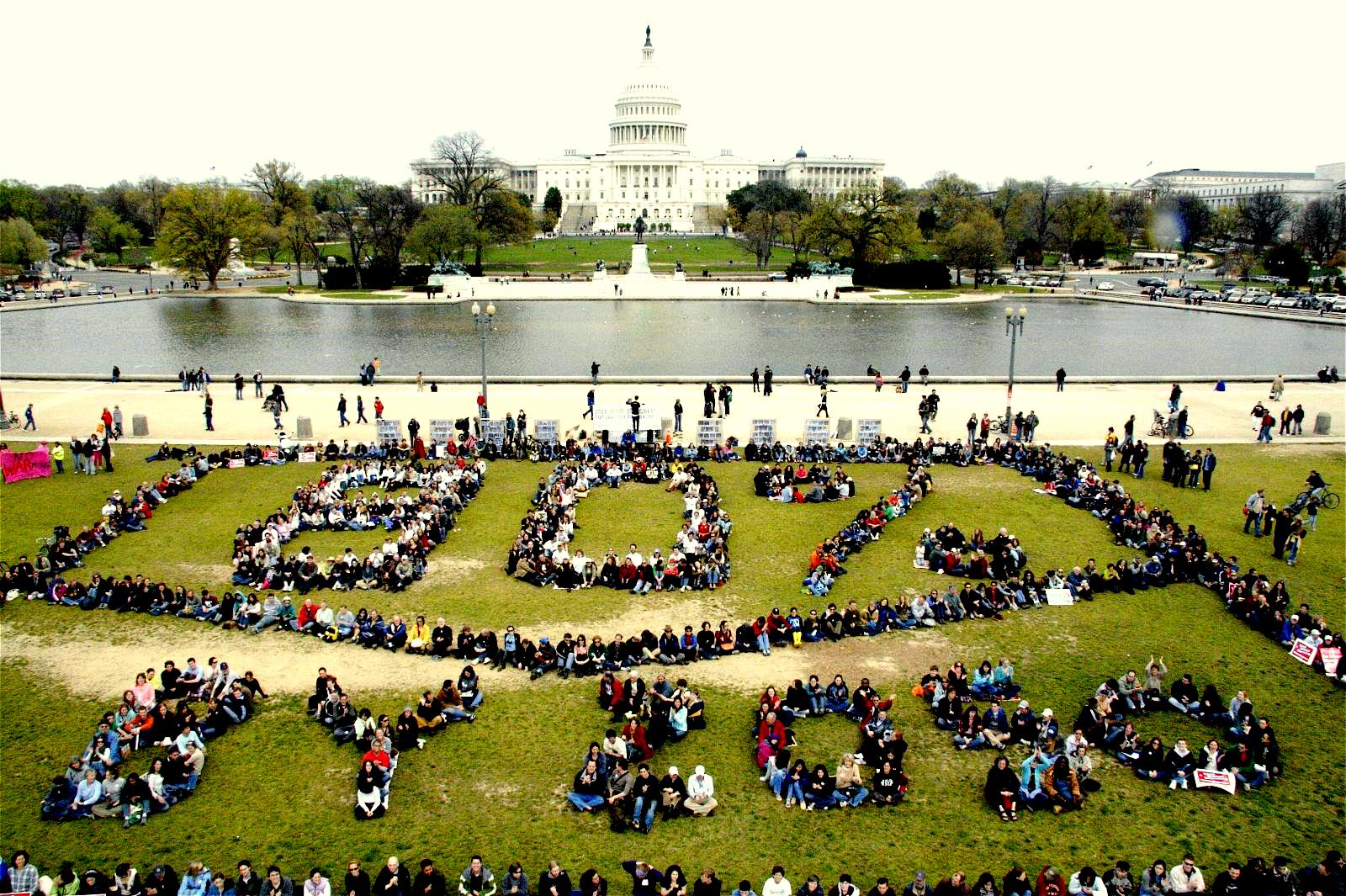 The cool thing about living in DC is it's damn convenient to protest the government. On April 14th, we participated in one of the nationwide National Day of Climate Action events. Our participation mostly consisted of being arranged into words and then photographed by a series of journalists. The message "80% by 2050" refers to the necessary cuts in greenhouse gas emissions over the next few decades. Congress is weighing several bills that would implement serious cuts in carbon emissions - although it's not clear if any of them will ever make it into law.
Laura Jean and I are on the lower right of the final "0" in "2050" -- click the image to see the full-res photo and you can sorta kinda make us out.
Saturday, April 28, 2007
Information is Power
There are 1,243 currently listed Superfund sites in the United States and 61 proposed sites that haven't been listed yet. These sites represent the worst toxic waste disasters in the United States, and have thus been singled out for special attention. Since 1980, only 319 sites have been cleaned up sufficiently to be deleted from the Superfund list. The map below contains all 1,623 sites. New Jersey has the most with 115 current and 3 proposed sites.

The Center for Public Integrity has a great site where you can search the map above to easily find the sites in your neighborhood. For what its worth, the EPA website has two similar maps here and here that I found harder to use, but did cough up some more detailed information. For example, here are the four Superfund sites in my hometown of Fresno, CA.

According to the EPA, at least 114 Superfund sites pose immediate health risks to nearby residents -- makes me wonder how many of those people even know that they have a toxic waste site in their neighborhood?
The CPI report alleges that the rate of cleanup of superfund sites has slowed significantly under the Bush administration. Critics ascribe this slowdown to budget cuts and a "lack of political will" at the Bush EPA; in their defense, Bush officials claim this is because the remaining sites are the tough ones, and that the "low-hanging fruit" have already been cleaned-up. CPI also provides a run-down on the 100 worst offenders - including the federal government and infamous polluters like General Electric.
Anyway, good reading. Via the Pump Handle.
The Center for Public Integrity has a great site where you can search the map above to easily find the sites in your neighborhood. For what its worth, the EPA website has two similar maps here and here that I found harder to use, but did cough up some more detailed information. For example, here are the four Superfund sites in my hometown of Fresno, CA.
According to the EPA, at least 114 Superfund sites pose immediate health risks to nearby residents -- makes me wonder how many of those people even know that they have a toxic waste site in their neighborhood?
The CPI report alleges that the rate of cleanup of superfund sites has slowed significantly under the Bush administration. Critics ascribe this slowdown to budget cuts and a "lack of political will" at the Bush EPA; in their defense, Bush officials claim this is because the remaining sites are the tough ones, and that the "low-hanging fruit" have already been cleaned-up. CPI also provides a run-down on the 100 worst offenders - including the federal government and infamous polluters like General Electric.
Anyway, good reading. Via the Pump Handle.
Sunday, March 04, 2007
If I Had A Hammer...
When all you have is a hammer, everything starts to look like a nail.
When it comes to foreign policy, George Bush only has one tool: the largest, shiniest, most expensive hammer the world has ever seen. A hammer so powerful that no nail has ever been able to withstand its force. Unfortunately, he keeps trying to use this hammer to reprogram computers -- with predictable results.
Consider: Iraq is a huge mess. Our invasion and occupation has resulted in hundreds of thousands of deaths, touched off a civil war, destabilized the region and utterly alienated most of the world. But I have a great idea, why don't we ... keep doing the exact same thing as before but with more troops! We'll call it a surge! That should work great!
Consider: Iran is (maybe) trying to create nuclear weapons and is (maybe) supplying arms to Shia militias in Iraq. That sure sucks! (Now we don't actually have any hard evidence of this, but, hey that's never stopped us before...) I know, why don't we ... drop some bombs on them! I'm sure that won't backfire and create more hatred towards the US! What could possibly go wrong?
Sarcasm aside, military might almost never triumphs over committed popular resistance (just ask any former colonial power). Our involvement is not just self-interested and destructive, it's also making things worse with each passing day. Of course, there are some things that we Americans could do to help create a better future there -- but they're long term stuff like (1) stop buying oil, (2) push for a serious solution to the Israeli-Palestinian conflict, (3) fund grassroots programs to improve educational and health access for women, and (4) I don't know, maybe stop supporting horrible dictators in the first place. This is the work of a generation.
In the short term: the time has come to leave. Our troops simply shouldn't be policing a civil war and it is time to bring them home. The American people support troop withdrawals -- heck even active duty soldiers are skeptical of the surge -- and the Democrats are searching for ways to make it happen. The fate of the Middle East ultimately rests in the hands of the people who live there -- they'll figure it out much faster than Bush will.

This picture is from last month's anti-war rally here in DC. The four-year anniversary of the war is coming up this month...
When it comes to foreign policy, George Bush only has one tool: the largest, shiniest, most expensive hammer the world has ever seen. A hammer so powerful that no nail has ever been able to withstand its force. Unfortunately, he keeps trying to use this hammer to reprogram computers -- with predictable results.
Consider: Iraq is a huge mess. Our invasion and occupation has resulted in hundreds of thousands of deaths, touched off a civil war, destabilized the region and utterly alienated most of the world. But I have a great idea, why don't we ... keep doing the exact same thing as before but with more troops! We'll call it a surge! That should work great!
Consider: Iran is (maybe) trying to create nuclear weapons and is (maybe) supplying arms to Shia militias in Iraq. That sure sucks! (Now we don't actually have any hard evidence of this, but, hey that's never stopped us before...) I know, why don't we ... drop some bombs on them! I'm sure that won't backfire and create more hatred towards the US! What could possibly go wrong?
Sarcasm aside, military might almost never triumphs over committed popular resistance (just ask any former colonial power). Our involvement is not just self-interested and destructive, it's also making things worse with each passing day. Of course, there are some things that we Americans could do to help create a better future there -- but they're long term stuff like (1) stop buying oil, (2) push for a serious solution to the Israeli-Palestinian conflict, (3) fund grassroots programs to improve educational and health access for women, and (4) I don't know, maybe stop supporting horrible dictators in the first place. This is the work of a generation.
In the short term: the time has come to leave. Our troops simply shouldn't be policing a civil war and it is time to bring them home. The American people support troop withdrawals -- heck even active duty soldiers are skeptical of the surge -- and the Democrats are searching for ways to make it happen. The fate of the Middle East ultimately rests in the hands of the people who live there -- they'll figure it out much faster than Bush will.
This picture is from last month's anti-war rally here in DC. The four-year anniversary of the war is coming up this month...
Monday, February 19, 2007
More on Global Warming
A few more random thoughts about the recent global warming Congressional hearings and the attendant media coverage.
- Firstly, our report was mentioned (albeit briefly and not by name) on the Colbert Report -- video can be found here. Seriously, how cool is that?
- There's a great interview with Dr. Drew Shindell (the NASA scientist who testified before Waxman) where he talks about political interference with his work, the danger of cutting funding for this type of research and global warming science in general.
- A lot of people get the sense that there has been a sea change on global warming just in the past few months, culminating with this latest round of media coverage on the hearings and the IPCC 4AR report. Prominent skeptics have recanted (although not Sen. James "Hoax" Inhofe), oil companies are unveiling significant voluntary programs to reduce greenhouse gas emissions (although not Exxon "$10,000" Mobil), and most significantly, the "center" of the debate has shifted. The media seems less likely to frame the very existence of anthropogenic global warming in terms of a "false balance" or a debate between "scientists" and has instead turned to the equally contentious problem of "what to do now."
- So: what to do now? The interesting policy questions are: what will the Democrats try to pass in this Congress and will President Bush veto it? There are several (bipartisan) options out there, some of which are authored by various presidential contenders. An excellent discussion of the many schools of thought on this can be found here. A lot of people seem to be saying that a serious national plan to address global warming will realistically have to wait for the next president to take office.
- On the Scientific Integrity front, we'll be pushing for legislation that addresses the rights of government scientists to do their work and communicate their findings free of fear. Wish us luck.
Subscribe to:
Posts (Atom)