Sunday, April 29, 2007

Step It Up

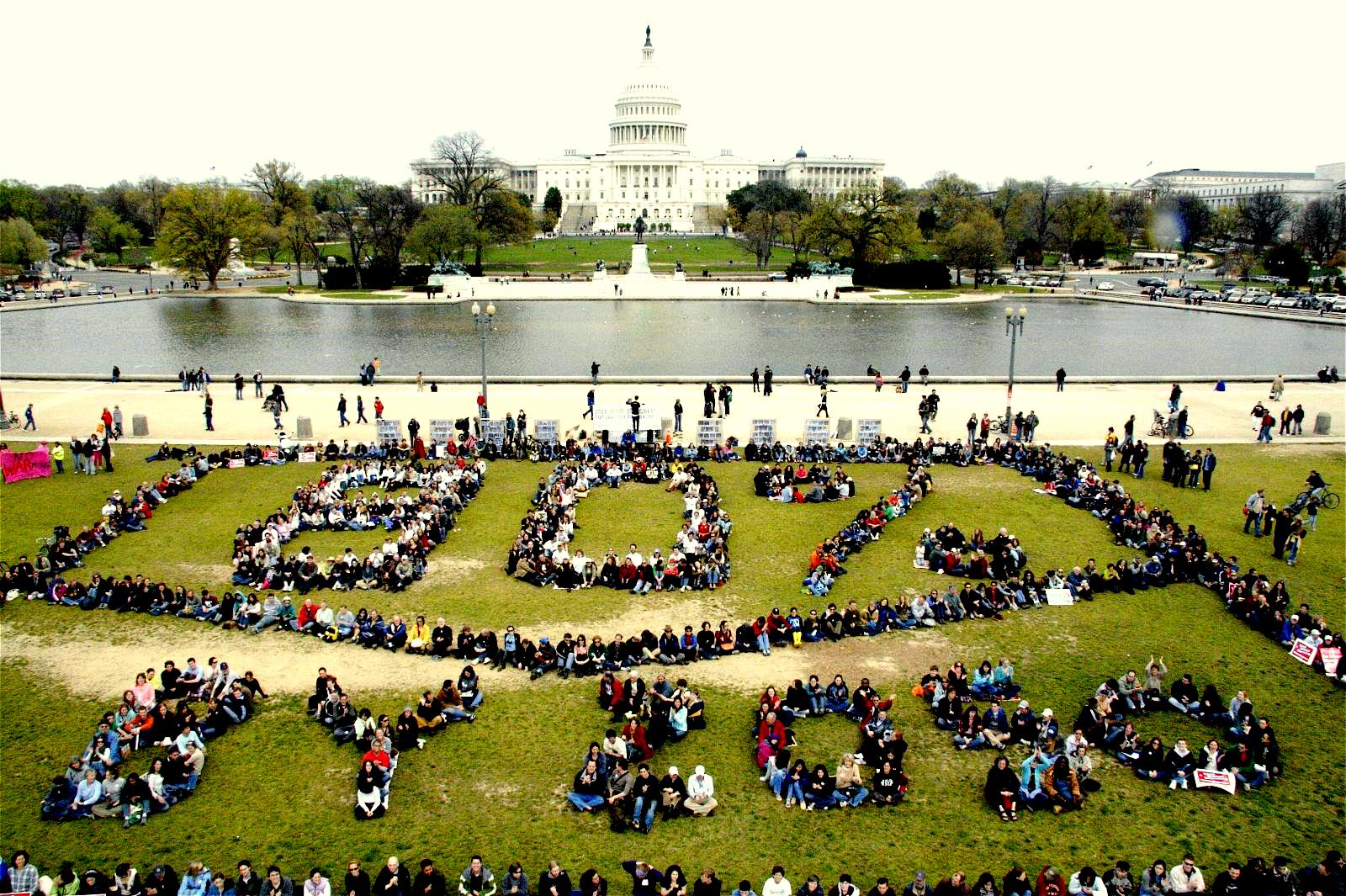
The cool thing about living in DC is it's damn convenient to protest the government. On April 14th, we participated in one of the nationwide National Day of Climate Action events. Our participation mostly consisted of being arranged into words and then photographed by a series of journalists. The message "80% by 2050" refers to the necessary cuts in greenhouse gas emissions over the next few decades. Congress is weighing several bills that would implement serious cuts in carbon emissions - although it's not clear if any of them will ever make it into law.

Laura Jean and I are on the lower right of the final "0" in "2050" -- click the image to see the full-res photo and you can sorta kinda make us out.

Saturday, April 28, 2007

Information is Power

There are 1,243 currently listed Superfund sites in the United States and 61 proposed sites that haven't been listed yet. These sites represent the worst toxic waste disasters in the United States, and have thus been singled out for special attention. Since 1980, only 319 sites have been cleaned up sufficiently to be deleted from the Superfund list. The map below contains all 1,623 sites. New Jersey has the most with 115 current and 3 proposed sites.

The Center for Public Integrity has a great site where you can search the map above to easily find the sites in your neighborhood. For what its worth, the EPA website has two similar maps here and here that I found harder to use, but did cough up some more detailed information. For example, here are the four Superfund sites in my hometown of Fresno, CA.

According to the EPA, at least 114 Superfund sites pose immediate health risks to nearby residents -- makes me wonder how many of those people even know that they have a toxic waste site in their neighborhood?

The CPI report alleges that the rate of cleanup of superfund sites has slowed significantly under the Bush administration. Critics ascribe this slowdown to budget cuts and a "lack of political will" at the Bush EPA; in their defense, Bush officials claim this is because the remaining sites are the tough ones, and that the "low-hanging fruit" have already been cleaned-up. CPI also provides a run-down on the 100 worst offenders - including the federal government and infamous polluters like General Electric.

Anyway, good reading. Via the Pump Handle.

Wednesday, April 25, 2007

Sign of the Coming Apocalypse #2702

Ice sheet melting in Greenland has created a new island (dubbed Warming Island by its discoverer) out of what was previously thought to be a peninsula. Via Gristmill, and also check out a map and pretty picture of the island courtesy of the NY Times.

The 'Framing Science' Kerfluffle

Matthew Nisbet and Chris Mooney have set off quite a to-do in the science blogosphere with articles in Science (full text here, scroll down and link is on the left sidebar) and the Washington Post. They call on scientists to adopt new methods for communicating their results to the wider public -- namely strategic 'framing' of scientific issues. They are both interesting articles and worth the read - as are (some of) the billion tons of electrons that have been spilt in response.

A few thoughts:
  • I confess when I saw Nisbet speak several months ago, my initial reaction was fairly negative. A first glance 'framing' sounds uncomfortably like 'spin.' Science is supposed to lay claim to a less-biased view of reality -- it slowly and methodically uncovers truths about our world and pushes them up to the surface. Should we really throw all that credibility and objectivity away just for the sake of convincing a few more people that evolution or global warming are really real? Does it make sense for scientists to descend to the level of the PR hack?
  • Lately, I've mostly come around to their way of thinking. Like it or not, framing is something that scientists do constantly. We've all fielded The Question from intelligent non-experts: "So what do you study anyway?" It would be nice to be able to explain to them in the fullest of detail the intricacies of your thesis (and some people try!), but in the real world you only have about 5 minutes (and probably less). You would like them to walk away feeling like they learned something, so you simplify, and you try to find a way of making it meaningful and interesting to them. That's framing - it's not evil. Since we already do it, we might as well learn to do it well.
  • Framing isn't a substitute for old-fashioned science education, but improving education will only yield results 20-30 years down the line. N&M's central point is that to impact public opinion about global warming (or evolution or stem cells or whatnot) over the next election cycle a communications game-plan is called for. This is essentially a political strategy (and hence the controversy), but I think the general point still holds. Framing happens whether we like it or not -- frame or be framed.
  • Somewhat amusingly, N&M have prompted some visceral negative blog reactions from the vocal atheist web-community -- notably biologist PZ Myers (here and here). I suspect much of this has to do less with the abstract idea of framing rather than with some of the specific frames they propose. In particular, their criticism of Richard Dawkins doesn't seem to have won them any converts. However the notion that attempting to frame evolution to make it more palatable to the largely religious American public is an unforgivable appeasement of religion strikes me as fairly narrow and silly. But that's fodder for another post.
  • Lastly: Can I just say that I find the entire field of communications research vaguely troubling? Are we all so uninformed and easily swayed by what we hear and read and see? Sadly it seems to be true, and the proof is that advertising works and works well. Our brains are apparently totally defenseless to suggestion and innuendo and, well, framing. Kinda terrifying, if you think about it.

Monday, April 16, 2007

Dragging Delayed

So my first experience with physics research was with the Gravity Probe B project, where I worked part-time for my first few years in college. GPB is a satellite mission, 40 years in the making, designed to measure frame-dragging -- a fairly subtle prediction of Einstein's General Theory of Relativity. GPB also amounted to a full-employment program for physics undergrads - at any rate, they allowed me to play around with physics experiments without a lot of pressure to churn out hard results. It was pretty cool introduction to physics research, but ultimately not the sort of project I was really interested in, so I eventually moved on to other stuff.

After going to grad school I realized that many astrophysicists actually held a rather dim view of GPB for a lot of different reasons. Dan Holz has an excellent post that explains the science behind the project, and some of the discontent.

Anyway, after 40 years of planning they finally launched the sucker in 2004 and were planning to unveil their Big Result this past weekend when suddenly ... they decided they needed more time to finish the exam. I guess what's a few more months of waiting after 40 years.

Monday, April 09, 2007

Mexico City

Here are a handful of my pictures from my late-November trip to Mexico City -- posted for your pleasure a mere 4 months late. The rest of the pics can be found here (snapfish login required).


The trip was a ton of fun and Mexico City is an amazing, endless city -- both beautiful and real at the same time. (Above are skeletons from the Frida Kahlo "Blue House" museum.)


Flying into Mexico City we could see Popocatepetl and Iztaccíhuatl, the legendary twin volcanoes overlooking the Valley of Mexico...


... however, most of the city was covered in a thick layer of brown haze. The metropolitan area has nearly 20 million people (3rd largest in the world behind Seoul and Tokyo) and a terrible air pollution problem.


My old college roommate, Julie who has been living in Mexico for six years now, met me at the airport and we had lunch overlooking the Zocalo, the central square of the city. Here, within yards of each other, you can find the city's Aztec past at the Templo Mayor, the legacy of Spanish colonialism in the Metropolitan Cathedral, and the National Palace, the hub of modern Mexico's government. In other words, tourist central.


Julie, overseeing the hubbub below.


A peaceful courtyard at the National Palace.


Julie riding the subway with a really awesome clown.


Here's the Metropolitan Cathedral, looming over some Communist flags (yep that's Marx in Stalin in the photos) and peacock feathers used by a group of traditional dancers.


The Zocalo is also home to all manner of political protests, and Mexican politics have been pretty interesting lately. Protest encampments lined the streets to draw attention to a variety of issues: from the bitterly disputed 2006 presidential election to the current uprising in Oaxaca to the continuing relevance of the Zapatista movement in Mexican politics.


Thousands of street vendors selling anything you could want.


Bustling street life, outdoor markets selling to tourists and locals alike.


The reason for the trip is that Starflight, the 3-d astronomy museum exhibit I helped pull together, was being shown at the Laboratorio Arte Alameda, and we were all invited down to help with the installation and attend the opening.


Here we have Starflight in action. The highlight of the trip for me was speaking (in my halting Spanish and their halting English) with the folks who came to opening. People generally thought it was pretty cool and we had some fun conversations -- there's nothing quite like describing abstract astronomical concepts in a second language to a group of artists.


One great thing about Mexico are the literally hundreds of gorgeous Diego Rivera murals dotting the city. Above is El Arsenal, prominently featuring Frida Kahlo as a worker...


... while this is Man, Controller of the Universe, mostly famous because the original was supposed to have been painted at the Rockefeller Center in New York, but was destroyed by John Rockefeller because of its explicit pro-Communist message (which was the subject of the movie, Cradle Will Rock).


By far the coolest things I saw in Mexico were the pyramids at the pre-Aztec city of Teotihuacan. Keith and I grabbed an early morning bus out to the site (about an hour outside of D.F.) and we mostly had the pyramids to ourselves for several hours. This is Keith descending the Pyramid of the Sun.


The smaller, but more ornate, Pyramid of the Moon.


Me on top of the Pyramid of the Moon.


A beautiful (if smoggy) sunset from my hotel room.


Behold! A winged cow!


Sadly, I only had a few hours to zoom through the fabulous National Museum of Anthropology, when I bet you really need a few months to do it justice.


These guys are Totonac indians performing the voladores rite, which is a really cool, if trippy, native tradition where they hang upside down and rotate around while playing music. The rumor I heard was that the Spaniards brutally stamped out many aspects of Aztec culture, but they let this one survive because they incorrectly thought it wasn't religious.


And lastly, I have to say D.F. has a subway system that is both one of the most extensive I've ever seen (outside NYC) and completely overwhelmed by the number of people who use it daily.

Can't wait to go back...

Monday, April 02, 2007

Burning Bright

I just had to pass on these three videos. Dark, very dark (as they say) - but also strangely beautiful. The second is my favorite.

Papillon D'Amour (Butterfly of Love)
http://www.youtube.com/watch?v=FOE73vrTGQ8

Tyger
http://www.youtube.com/watch?v=6LsMoUtBlDk

Rabbit
http://www.youtube.com/watch?v=A4Yf-7Z_6PE

(via Neil Gaiman.)

Saturday, March 31, 2007

The three silliest things I've read lately...

A pinch of bureaucrat-ese, a smidgen of imprecise language and some garden-variety human foolishness...
  • In the 2006-2011 Environmental Protection Agency (EPA) Strategic Plan (pdf, page 22) I found the following institutional goal:
    "By 2165, reduce the incidence of melanoma skin cancer to 14 new skin cancer cases avoided per 100,000 people from the 1990 baseline of 13.8 cases avoided per 100,000 people."
    The report gives no context for this statement so it's hard to know exactly what they're talking about or how they plan to achieve this goal, but still... I don't know whether to be impressed that they're thinking so far ahead or depressed that they set their sights so low. I mean, what are the odds we'll still even have an EPA in 2165? Unless the EPA starts doing their job on climate change melanoma will be the least of our problems by then.
  • Then we have a vague warning from a book on household and office health hazards:
    "Other studies suggest computers might be a source of electromagnetic radiation."
    Gee, you think? Apart from the fact that the primary purpose of a computer monitor is to emit electromagnetic radiation (i.e. light), I suspect they might be missing a modifier here. It's certainly conceivable that computers might be a source of harmful high-energy electromagnetic radiation (I honestly have no idea) -- but, as written, the sentence would seem to implicate every lump of normal matter in the known universe.
  • I've blogged before about Fish & Wildlife Service political appointee Julie MacDonald who has a history of arbitrarily over-ruling (and verbally abusing) FWS scientists in order to avoid placing animals on the endangered list. This week the Inspector General's office of the Dept. of the Interior released it's report (pdf) on Ms. MacDonald's malfeasance. The report is full of damning interviews with her colleagues and evidence that she leaked sensitive documents to law firms fighting the Endangered Species Act. However, our intern Meredith found a hilarious passage buried on page 21 involving internet role-playing games. TMP Muckraker also noticed the passage and has the details. Pretty funny.

Sunday, March 18, 2007

Power to the Peaceful

We saw Michael Franti & Spearhead Friday night at the 9:30 Club -- a show which was partially a benefit for Iraq Veterans Against the War.

If you're not familiar with his music, he's a great hodgepodge of reggae, funk, hip-hop, soul and rock -- and an endless fount of danceable protest songs (listen here).

Anyway, it was a great and uplifting show. Sometimes you just need to jump up and down to a blast of goofy, end-the-war, music-will-set-us-free idealism. My only complaint is that for the last 4-5 songs of the set there was a breakdown somewhere along the singer's voice to soundsystem to eardrum pathway, and some unpleasant feedbacks along the way knocked the sound mix out of wack.

Sound system problems aside, you've got to love a guy who can follow-up a Bob Marley cover with the theme from Sesame Street. Pretty awesome.

Sunday, March 11, 2007

winter into spring

Before I left Chicago I fell into the habit of taking a picture of the streetcorner outside our apartment each morning before I went to work. I collected 118 images from February 9 through July 4, 2006 (meaning there were 28 days that I forgot, or was out of town). Here they are wrapped into a short movie.


The pictures aren't perfectly aligned (although I might try to make panotools do the alignment someday...) but it's still kind of neat to see the slow change of the seasons and the way the light changes from day to day. Still, it seems like it needs a soundtrack somehow -- although YouTube would probably nix that eventually. George Winston seems an obvious choice, but I was also thinking Mos Def's "May-December" would work nicely. Any other thoughts?

(For the record, I got this idea from watching Paul Auster and Wayne Wang's charmingly unusual film Smoke). Enjoy!

Saturday, March 10, 2007

The new Bob Dylan album

Bob returns to his musical roots with a series of songs adapted from a beloved American poet: Dylan Hears A Who. In addition to being pretty durn funny, the tunes are actually surprisingly good (and very very Dylan-esque). And it all makes a twisted sort of sense if you think about.

Sunday, March 04, 2007

If I Had A Hammer...

When all you have is a hammer, everything starts to look like a nail.

When it comes to foreign policy, George Bush only has one tool: the largest, shiniest, most expensive hammer the world has ever seen. A hammer so powerful that no nail has ever been able to withstand its force. Unfortunately, he keeps trying to use this hammer to reprogram computers -- with predictable results.

Consider: Iraq is a huge mess. Our invasion and occupation has resulted in hundreds of thousands of deaths, touched off a civil war, destabilized the region and utterly alienated most of the world. But I have a great idea, why don't we ... keep doing the exact same thing as before but with more troops! We'll call it a surge! That should work great!

Consider: Iran is (maybe) trying to create nuclear weapons and is (maybe) supplying arms to Shia militias in Iraq. That sure sucks! (Now we don't actually have any hard evidence of this, but, hey that's never stopped us before...) I know, why don't we ... drop some bombs on them! I'm sure that won't backfire and create more hatred towards the US! What could possibly go wrong?

Sarcasm aside, military might almost never triumphs over committed popular resistance (just ask any former colonial power). Our involvement is not just self-interested and destructive, it's also making things worse with each passing day. Of course, there are some things that we Americans could do to help create a better future there -- but they're long term stuff like (1) stop buying oil, (2) push for a serious solution to the Israeli-Palestinian conflict, (3) fund grassroots programs to improve educational and health access for women, and (4) I don't know, maybe stop supporting horrible dictators in the first place. This is the work of a generation.

In the short term: the time has come to leave. Our troops simply shouldn't be policing a civil war and it is time to bring them home. The American people support troop withdrawals -- heck even active duty soldiers are skeptical of the surge -- and the Democrats are searching for ways to make it happen. The fate of the Middle East ultimately rests in the hands of the people who live there -- they'll figure it out much faster than Bush will.


This picture is from last month's anti-war rally here in DC. The four-year anniversary of the war is coming up this month...

Tuesday, February 27, 2007

Freakonomics

I finally got around to reading Steven Levitt and Stephen Dubner's Freakonomics; it's a quick and interesting read with lots of fascinating case studies, although frustratingly inconsistent. I think the main takeaway point is that a lot of "conventional wisdom" floating around out there in the ether is either plain wrong or grossly simplified. To which I say: fair enough.

The weird thing is that Levitt is portrayed as some dis-interested oracle of pure truth, slaying the sacred cows and dispelling common misperceptions. The book makes almost no mention of the fact that many of the ideas Levitt debunks are the product of ongoing social science research, not just the uninformed opinions of pundits and taste-makers. He's clearly a talented and original thinker who has written a number of surprising and influential papers -- but I doubt he's written the final word on such complicated sociological puzzles like the causes of crime or the black-white testing gap. There is also a lack of explanatory power in some of the ideas presented; Freakonomics often seems far better at debunking old ideas than it is in backing up its clever, simplistic alternatives or forging connections between its disparate topics.

The big controversial finding presented in the book is of course Levitt's assertion that the precipitous drop in crime during the early 1990s is best explained by the advent of Roe v. Wade twenty years earlier, and not by any of the dozen more common explanations (the boom economy, gun laws, better policing, etc.). The idea here being that mothers often make decisions about abortion based on their personal and financial ability to raise the child at that time in their life, and apparently that such factors are also strong predictors of 'criminal behavior' in the child. This is the book in a nutshell: bold, clever, unexpected, disturbing ... but true?

It is a somewhat troubling assertion no matter your stance on abortion. But even ignoring for now the merits of the argument it doesn't seem to fit with the rest of the book. Levitt is fundamentally asserting that a child's nurturing environment (or lack thereof) is key in predicting that child's outcome later in life (at least with regards to crime). So it's puzzling that a big chunk of the book is devoted to arguing that parenting style (i.e. reading to your child or taking them to museums or letting them watch TV) has essentially no impact on how well a child does in school. I'm probably missing some obvious unstated argument here, but this seems like a fairly big disconnect to me. Or maybe I'm hoping for a larger theory or organizing principal of human behavior that just isn't there.

Anyway, there's a lot to like in the book -- the chapter on the economics of drug dealing is really cool and their occasional column in the NY Times is also great -- but take it with a grain of salt. Provocative ideas are not always the full story.

Monday, February 19, 2007

1100100

Hey- this is my 100th blog post!

More on Global Warming

A few more random thoughts about the recent global warming Congressional hearings and the attendant media coverage.
  • Firstly, our report was mentioned (albeit briefly and not by name) on the Colbert Report -- video can be found here. Seriously, how cool is that?
  • There's a great interview with Dr. Drew Shindell (the NASA scientist who testified before Waxman) where he talks about political interference with his work, the danger of cutting funding for this type of research and global warming science in general.
  • A lot of people get the sense that there has been a sea change on global warming just in the past few months, culminating with this latest round of media coverage on the hearings and the IPCC 4AR report. Prominent skeptics have recanted (although not Sen. James "Hoax" Inhofe), oil companies are unveiling significant voluntary programs to reduce greenhouse gas emissions (although not Exxon "$10,000" Mobil), and most significantly, the "center" of the debate has shifted. The media seems less likely to frame the very existence of anthropogenic global warming in terms of a "false balance" or a debate between "scientists" and has instead turned to the equally contentious problem of "what to do now."
  • So: what to do now? The interesting policy questions are: what will the Democrats try to pass in this Congress and will President Bush veto it? There are several (bipartisan) options out there, some of which are authored by various presidential contenders. An excellent discussion of the many schools of thought on this can be found here. A lot of people seem to be saying that a serious national plan to address global warming will realistically have to wait for the next president to take office.
  • On the Scientific Integrity front, we'll be pushing for legislation that addresses the rights of government scientists to do their work and communicate their findings free of fear. Wish us luck.

Thursday, February 01, 2007

Well said

A co-worker passed on this quote today. It seemed like a fitting epitaph for a funny and inspiring writer - thought I would share.

"So keep fightin' for freedom and justice, beloveds, but don't you forget to have fun doin' it. Lord, let your laughter ring forth. Be outrageous, ridicule the fraidy-cats, rejoice in all the oddities that freedom can produce. And when you get through kickin' ass and celebratin' the sheer joy of a good fight, be sure to tell those who come after how much fun it was."

-Molly Ivins (1944-2007)

Wednesday, January 31, 2007

Testify!

Yesterday was the first hearing by the House Oversight and Government Reform Committee under the new Chairman Henry Waxman (D-CA). The topic of the hearing was political interference in the work of government climate change scientists -- the exact subject of the scientist survey and report we've been frantically working on for the past several months. Since my boss was called as one of the four witnesses, we took the opportunity to release our report and call for an end to interference in the work government scientists.

We only found out about the hearing last Monday, so basically my life for the past 9 days has been completely consumed by the tasks of (1) finishing the report, (2) getting it designed and printed, (3) taking care of the 637 billion other things needed for a successful hearing and report release. So after all those long hours, it's nice that the hearing was a success. The Democrats on the committee were all strong supporters of our position on this issue, and most of the handful of Republicans who showed up were fairly moderate.

I say 'most' because Rep. Darrell Issa (R-CA) led off with an ad hominem attack on UCS and followed that up with a weak attempt to discredit the methodology of our survey. The National Review decided to repeat this critique in a blog post labeling us the "Union of Junk Scientists." Heh. I would rebut this argument, but Chris Mooney has already hit the nail on the head as to why this attack entirely misses the point (see here and here). So goes the political theater.

Anyway, the report and the hearing got a ton of media coverage -- most of it pretty positive. Apparently my face appeared on CNN for a few seconds, wahoo! The story got picked up by AP, Washington Post, New York Times, LA Times, US News and World Report, San Francisco Chronicle, and Chicago Tribune among others. Michael, Francesca and Tarek also did interviews for several local TV affiliates.

You can see the video of the entire hearing by clicking here. That's me sitting behind Francesca and occassionally passing her notes - you have to scroll ahead for a long time to see me since there were over 70 minutes of opening statements. And beware: it goes on for almost 4 hours. There's also a few snippets up on You Tube. A few interesting blog reactions about hurricanes and cherry-picking can be found from Roger Pielke Jr. (the 4th witness suggested by the Republican side) and Real Climate. If you're interested in reading the report (titled Atmosphere of Pressure and co-authored by the Government Accountability Project) it can be downloaded here along with more information of the investigation and other incidents of political interference in science.

I'll post more about the actual content of the hearing at some point, but for starters it's a huge step in the right direction that it happened at all. Waxman appears to be a great ally on the issue of scientific integrity. The next step is definitely to push for actual reforms at federal agencies that protect scientists basic rights and let them get back to the job we're paying them to do.
Thursday, January 18, 2007

cinema vs. celebrity

We went to the movies the other night and the price for a regular ticket was $10! No attempt to paper over the fact that you're being totally screwed: $10 straight up. Unsurprisingly the enormous theatre was almost empty. Totally ridiculous -- and it's too bad because I really love seeing good movies on the big screen. Chicago had an awesome student-run film series and we would buy passes and go almost weekly to see second-run blockbusters, art films, foreign films, cult classics, you name it. Cut the price of a movie ticket in half and I for one would go to the movies more than twice as often.

What's more, there are definitely certain movies that you really do want to see on the big screen, and others that you might as well wait for on Netflix. This most recent shakedown reminded me that not only should a movie be pretty good to warrant ten bucks, it should also have a certain cinematic quality that's lost when seeing it on your 12" TV. I've talked before about how I have a soft spot in my heart for intrinsically cinematic movies -- films with that rush of moving image excitement you just can't get from the printed word or even a stage play. By this I don't specifically mean action movies with explosions, or even 'tasteful' costume design or 'lush' cinematography. It's more intangible than that: Lord of the Rings, Lawrence of Arabia, even the original Star Wars ... stuff like that.

Can I also gripe for a minute about the ascendancy of the biopic? By this I mean a movie primarily about the life of a celebrity. Over the last few years Hollywood has provided us with impressive documentation of the lives of the famous and name-worthy. To mention a few (Oscar contenders all): Ray, Walk The Line (which is the exact same movie as Ray), Capote, the Aviator, Finding Neverland, Kinsey, the Motorcycle Diaries, the Hours, Frida, A Beautiful Mind, Ali, Iris, Before Night Falls, Pollock, Quills, the Hurricane, Malcolm X, Nixon, Gandhi to name just a few. This year brings us several more biopics (The Queen and The Last King of Scotland) that are at the top of everyone's Oscar lists. Apparently the highest accolades accrue to movie stars playing yet another famous person.


My gripe with these movies is not that they're bad: some are certainly tedious, but others I would rank among my faves. Rather, the problem is that they're a bit lazy. Your typical biopic often has (1) an eye-catching performance in the titular role, and (2) a lousy story. This is a simple consequence of the fact that the lives of famous people (even someone as nutty as Howard Hughes) are simply not interesting enough to warrant a full-length motion picture about their year-to-year existence.

The best of the bunch succeed in spite of the genre's limitations. Gandhi is really the story of the founding of modern India, Ray succeeds on the considerable strength of the music, and the Motorcycle Diaries is a story about personal awakening to injustice. But, even when watching your better biographies I often wonder whether these interesting themes could just as easily be the basis for telling a new story, rather than draping them across the mundane biographical outline of a real person's life.

For example, one of the most interesting movies I've seen recently was actually a fake biography: Velvet Goldmine (I've raved about the sweet soundtrack elsewhere). The movie takes the 70's glam-rock milieu of Roxy Music, Brian Eno and David Bowie and crafts a fictional story about a very Bowie-esque rock star. You gotta love any film the ties together Oscar Wilde, space aliens, talking Ken dolls and several tons of glitter make-up. Unlike the fictional John Slade, Bowie never faked his own death on stage, but it sorta seems like something he might have tried. And the stunt doubles as a great metaphor for glam-rock's death at the hands of 80s-pop, for Bowie's perpetual reinventions and for the end of a certain sexual idealism in our popular culture. VG isn't tied down by the tyrannies of fact and history, and that freedom seems to allow it to say something far more true and interesting.

To return to my earlier point, when you strip away the remakes of TV shows, biopics, adaptations of books, comics and extended SNL skits, is there anyone in Hollywood actually telling original stories in films? Or, put it another way, which movies need to be seen as films in order to truly capture their spirit. A few come to mind that you couldn't even begin to reproduce
as a book, a TV show, a stage play, a comic book, a newscast: Eternal Sunshine of the Spotless Mind, City of God, Mulholland Drive, 2046, Pulp Fiction, animation from Pixar, Miyazaki or Aardman. These types of films won't win Best Picture, but might garner an Original Screenplay nomination. These types of films I would pay $10 to see again and again.

Tuesday, January 16, 2007

Baby's First Protest


Here's Laura Jean holding our 2-year-old niece Grace, who was attending her first protest yesterday. In honor of Martin Luther King we came to the Save Darfur rally outside the Sudanese Embassy.


As I've said before, the Save Darfur movement sometimes strikes me as a little odd because its organizers and supporters are clearly passionate but often don't provide a deeper analysis as to why genocide occurs or what systematic things we can do to stop future atrocities. Which is not to say it's not a timely and deeply important cause to take up -- clearly, it's better to act than endlessly ponder political theories, especially when quick action can save lives. But it will be interesting to see where the energy goes once confronted with either victory or continued apathy.

And really, this particular rally was far better than others at drawing the important connections between war and racism and genocide. Several of the excellent speakers drew connections to Dr. King's radical rejection of the Vietnam war and Rep. Tom Lantos (the only living Holocaust survivor in Congress) announced plans to hold hearings on the issue. May they be heard.